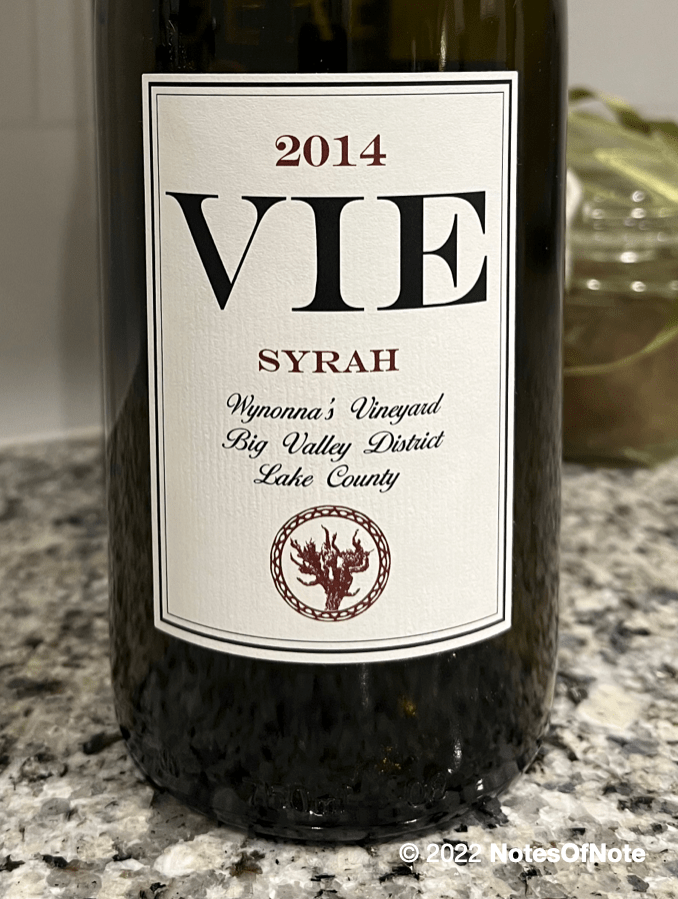
2014 Syrah, Vie Winery

Red blends recently caught my eye while buying online, and the 2017 Walt’s Old Vines from Judd’s Hill was one of the batch. Now, I’m an easy sell for any ‘old wines’ grapes, and that bias generally serves me well—just as it did here with this Napa Valley bottle.
The winery is family run, and proud of it. Judd’s Hill produces not only well-known California treats like Cab Sauvignon and Pinot Noir, but also less-frequent AVA guests like Viognier and Grenache. They’re also sharing prominently the Judd’s Hill focus on small lot wines, and all that gears one up for a great tasting experience. That’s exactly what I enjoyed here with the 2017 Walt’s Old Vines Red Blend.
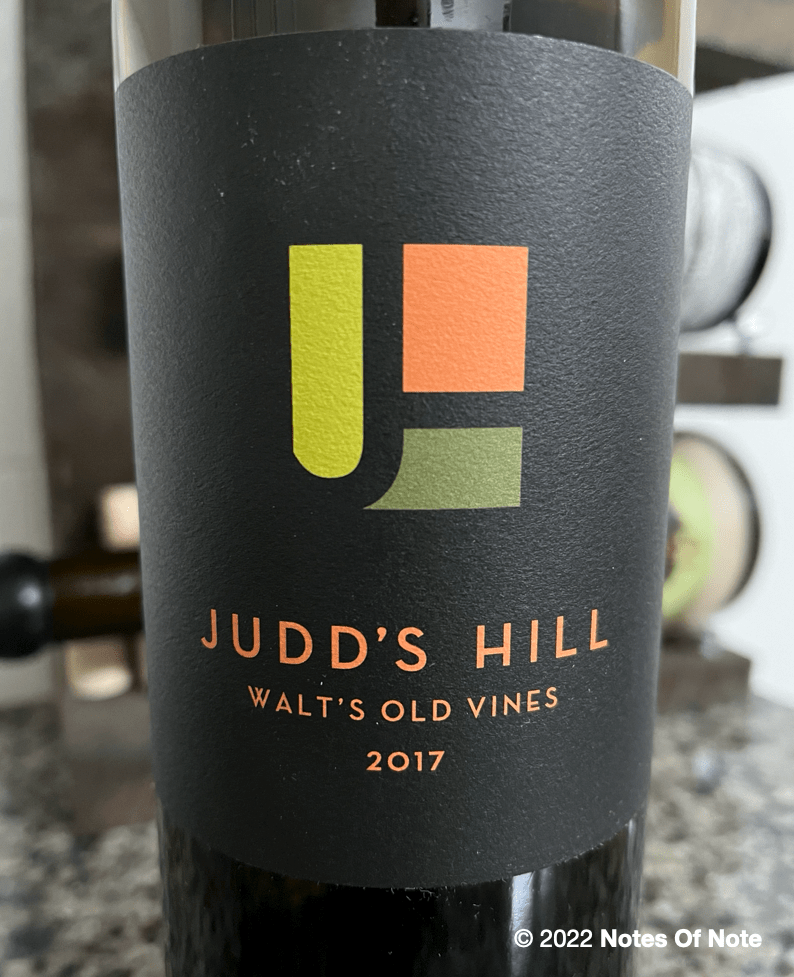
This 2017 growls softly at you. The wine is replete with berry goodness, an explosion of blueberry and blackberry on your palate. Those are the obvious notes, but others are at play too. The winery’s website indicates “marionberry, huckleberry, and lingonberry” are also conveyed in Walt’s Old Vines, but I simply don’t have the palate or previous taste for any of those more subtle hints. Check it out and let me know? I do get a gentle whiff of pepper, but it is very faint—not as pronounced as a Syrah or Zin. The aftertaste has slightly less rounded notes, a bitterer profile that I’d think more like a cranberry vibe. All in all, it’s really quite enjoyable!
If you’re trying to find the 2017 Walt’s Old Vines Red Blend from Judd’s Hill, you might see results including the Cuttings (The Prisoner Wine Company), Machete (Orin Swift Wines), or even Scout’s Honor (Venge Vineyards) in your search feed. Each of these Napa Valley greats has a profile similar to Walt’s and would serve you and your guests very well. I bought two the first time out and encourage you to better that score when you make your buy. You’re welcome—and thanks for reading.



Conundrum is always a great option for your vino fix, a proprietary red blend that Notes has covered many times and in many ways over the years. This site has covered bottles going back nearly a decade, and be sure to cruise notes on the 2012, 2013 (there are several) and even the 2014, or others at your convenience. I am not sure how I missed a vintage in this vertical but looking to make up for that here.
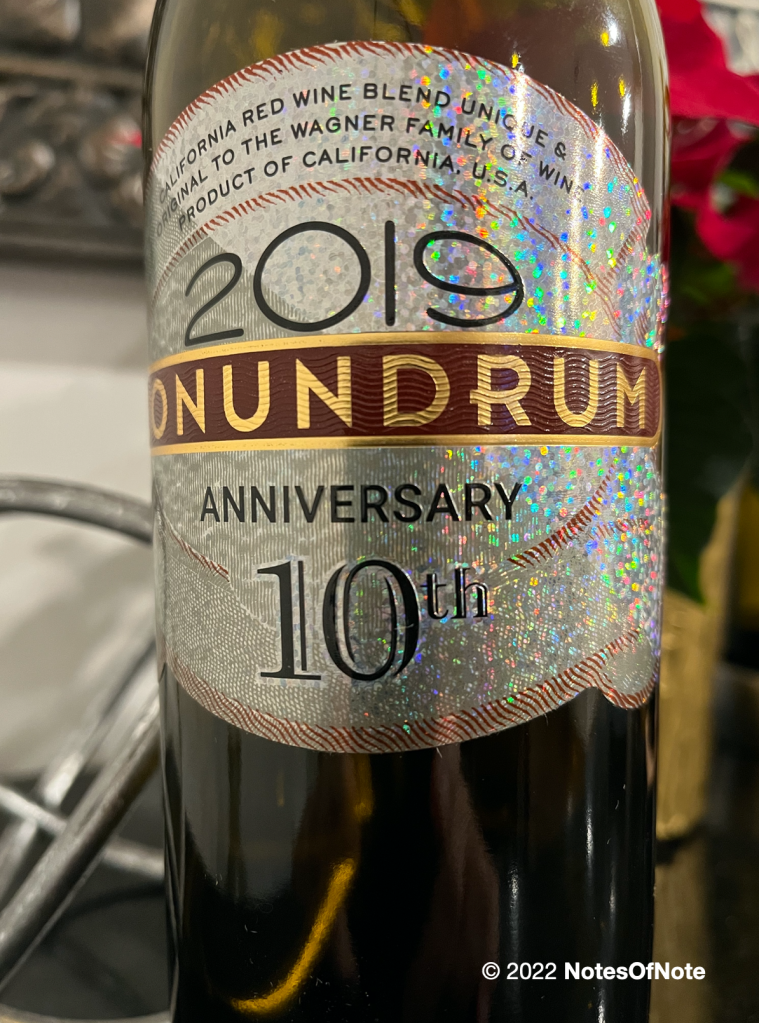
It’s a flavor bomb, a tooth-stainer of a red that has fans all over the world. As with previous vintages, the 2019 Conundrum is jammy and packs in the dark berry goodness. Sampling Conundrum for the first time or the 100th you’ll surely detect the dark cherry or plum notes, the leggy red tumbling full and inky into your glass. I have occasionally whiffed a little hint of vanilla in the mix, but this particular bottle had more of the fruit than the spice as defining characteristics. It had a few minutes to breathe but was essentially ready to enjoy right away without decanting, filtering, or similar preparation.
Yes the label is eye-catching, but less so than the Wagner name (Notes covers many of those, too) for most oenophiles. On the other hand, I’ve missed recent vintages of Conundrum so the silver did work as a marketing tool.
Polished off this 2019 tonight with a healthy tilapia (white wine, butter, garlic/caper goodness), broccoli, and apple sauce dinner. Trying to make good decisions early and often in 2022, and hoping your new year is off to a similar good start. Thanks for reading and best in the year ahead.

Time to ring in the new year, and no better way to celebrate the passing of 2021 than with a Buena Vista red. Here is the 2019 Private Reserve Zinfandel, a small production run of just 550 cases, and one bottle therefrom made its way into my fall shipment from the vineyard.
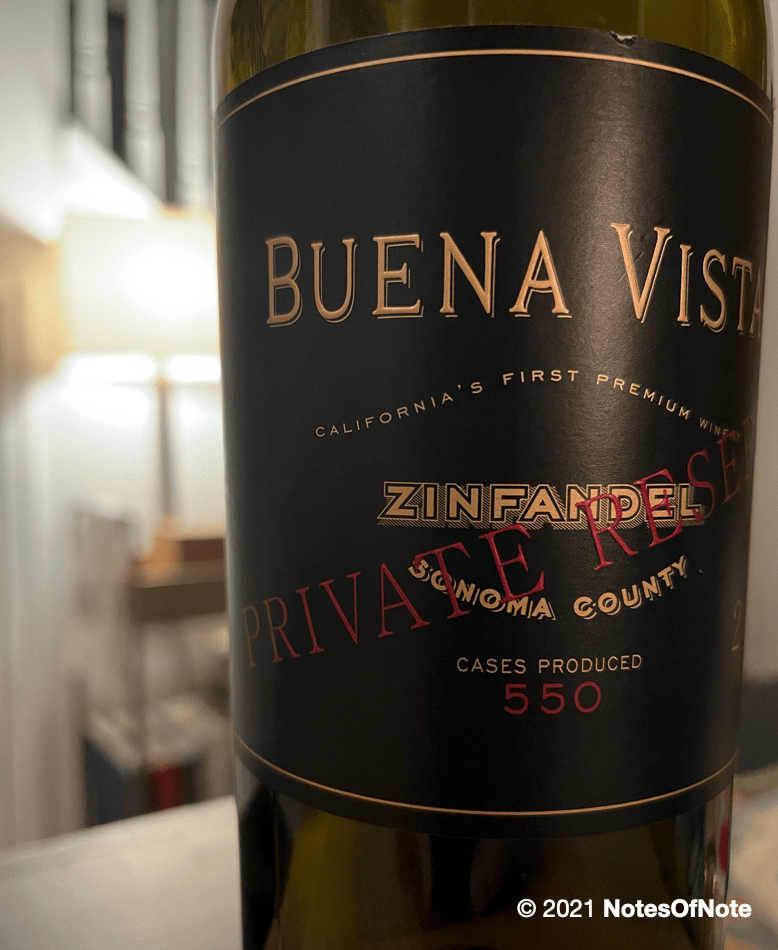
Let’s take a moment and break down this “get,” shall we? The 2019 Private Reserve Zin is produced by one of the oldest vineyards in the US, located in Sonoma, California. It is less jammy, less sweet than other Zins you might sample. Those notes may be part of the wine; they may also be partially a result of my penchant for rushing a pour instead of letting a new bottle breathe for a spell.
It shares a bit of strawberry on the nose, and it’s a bit spicy too, but has more of a cherry slant when you’re actually tasting the wine. The 2019 Private Reserve Zinfandel is full-bodied and rich on your palate. While I cannot speak authoritatively on this vintage, the Buena Vista Private Reserve Zins are usually hand-picked and fermented separately in open-top vats prior to pressing and aging in French, Hungarian (yes, Cara and Lauren!), and American oak barrels. I’ve also had the good fortune to sample the 2012 and 2015 Private Reserve Zin, and I’d encourage you to check out those notes—and drink the wine—at your convenience.
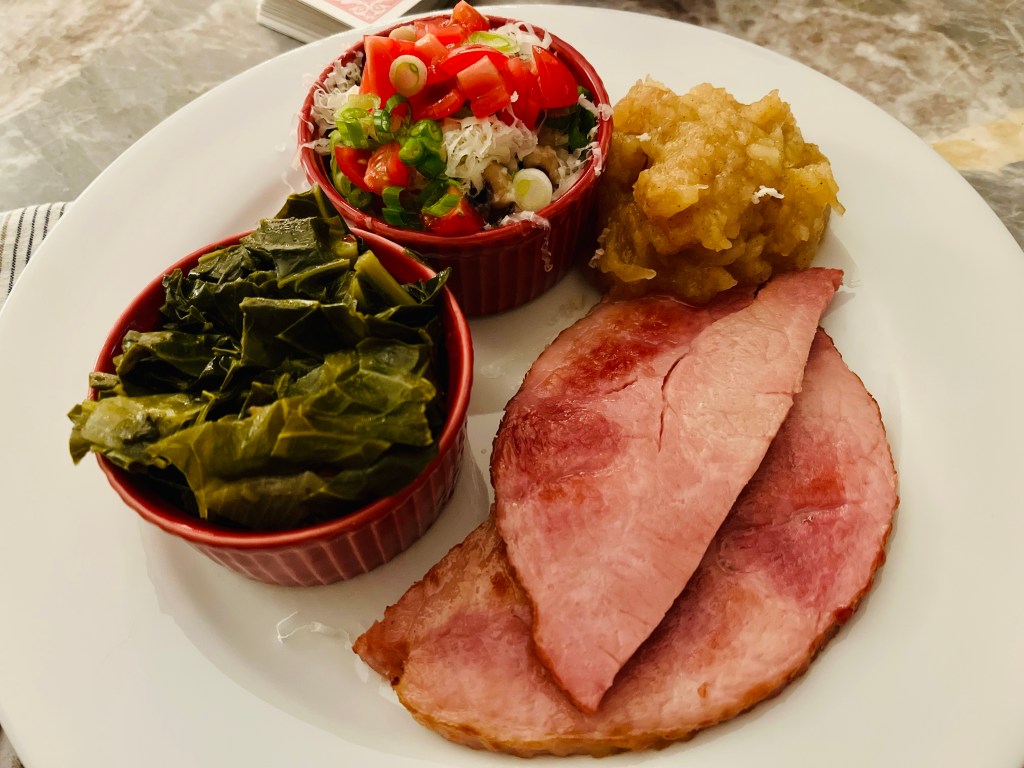
Special thanks to Loona for ensuring the fridge was stocked with our delicious New Year’s Eve supper. It was so thoughtful, and wonderful to see the little plates and ramekins labeled with your careful instructions! Here’s our interpretation of your prep: the holiday ham, the collared greens, the black-eyed peas with all the fixin’s, and even homemade apple sauce. The wine is just a capper on a great bit of ambiance curated for our celebration.
Already 2022 feels lucky by comparison. Hoisting a glass to health, home, and loved ones near and far. Hoping your own celebrations take on special meaning, and best to us all in the year ahead.

Broke out this 2017 Cakebread Cellars Cabernet Sauvignon to help celebrate the special occasion. Cakebread has built quite the cult following (big fan of their Chardonnay in particular in our house) over the past 50 years or so, and we’re so glad to open up a flagship red for Christmas.

It’s a big new world wine. Inky in the glass (we’re doing Cabernet stemware today) and plenty of legs, too. This guy rarely has the patience (or forethought) to let a bottle breathe adequately, but this one did have the better part of an hour to open up before splashing down into our dinner glasses. On the nose you experience dark cherry, maybe just a hint of vanilla or perhaps tobacco underpinning the fruit. The 2017 Cakebread Cabernet Sauvignon is well balanced on the palate, with a slightly tannic finish. This wine is full, to be sure, but avoids the jammy, tooth-stainer profile to which I often gravitate in weekend tastings.
This particular Cakebread accompanied a really delicious cut of beef, a prime rib that had a great bark and a red, juicy center that was perfectly accented by homemade horseradish sauce. To know me is to know I enjoy salty steak and reds in equal measures, but the seasoning and the sauce were just great even without salt. Our Christmas table also included hasselback potatoes, Tuscan kale, popovers (yes, complete with Christmas tree butter, because those finishing touches matter!) and carmelized onion and mushrooms. The house smelled fragrant, a mash up of the beef, garlic, rosemary, and all those aromatics, and added to these heady scents soon was the smell of our dessert (jelly roll consisting of sponge cake and apricot).
Part of the fun with this wine was splitting it four ways, ensuring each of us had a chance to sample the 2017. It was great; the only negative as you might imagine is that we’d only had one on hand for the holiday. I regret it’s taken so long to take up the reviews here at Notes Of Note but encouraging you to stick with it—few good wines from the world over are sure to follow shortly.
In the meantime, season’s greetings to you and best in the year ahead. Thanks for reading!

Life often gets in the way of a timely Notes review, and I look up and see several bottles that have passed by my table without getting their due review. I try to share a “quarterly update” of sorts…perhaps it is of no value whatsoever, but I take this step in part so you as visitors have better context for those wines I do ultimately review.
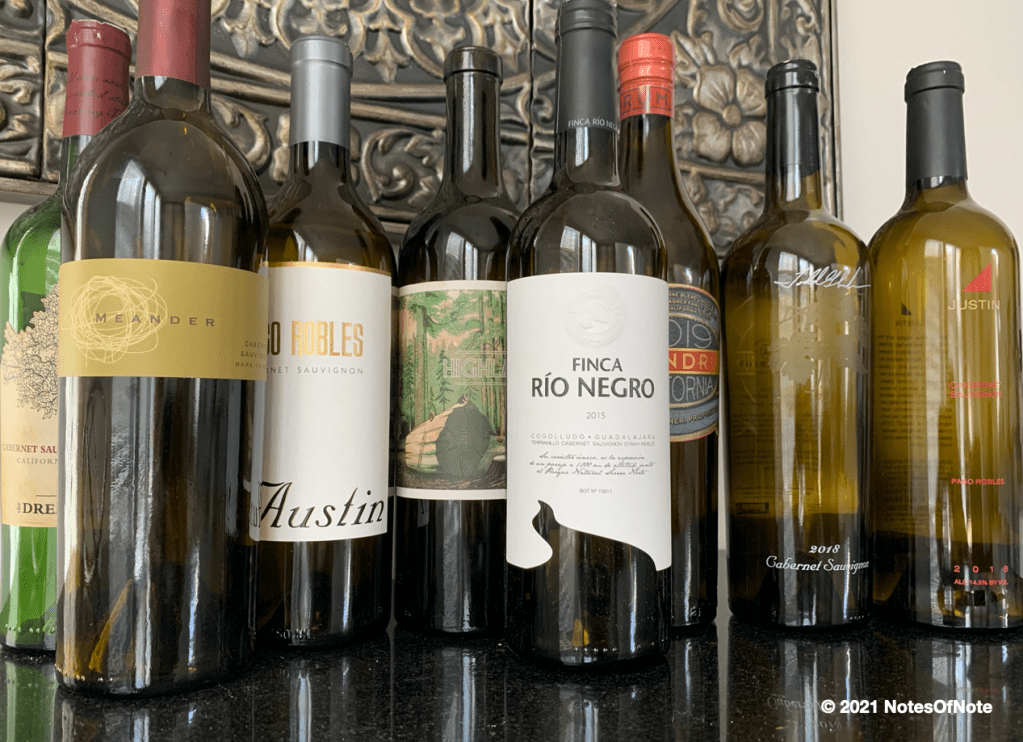
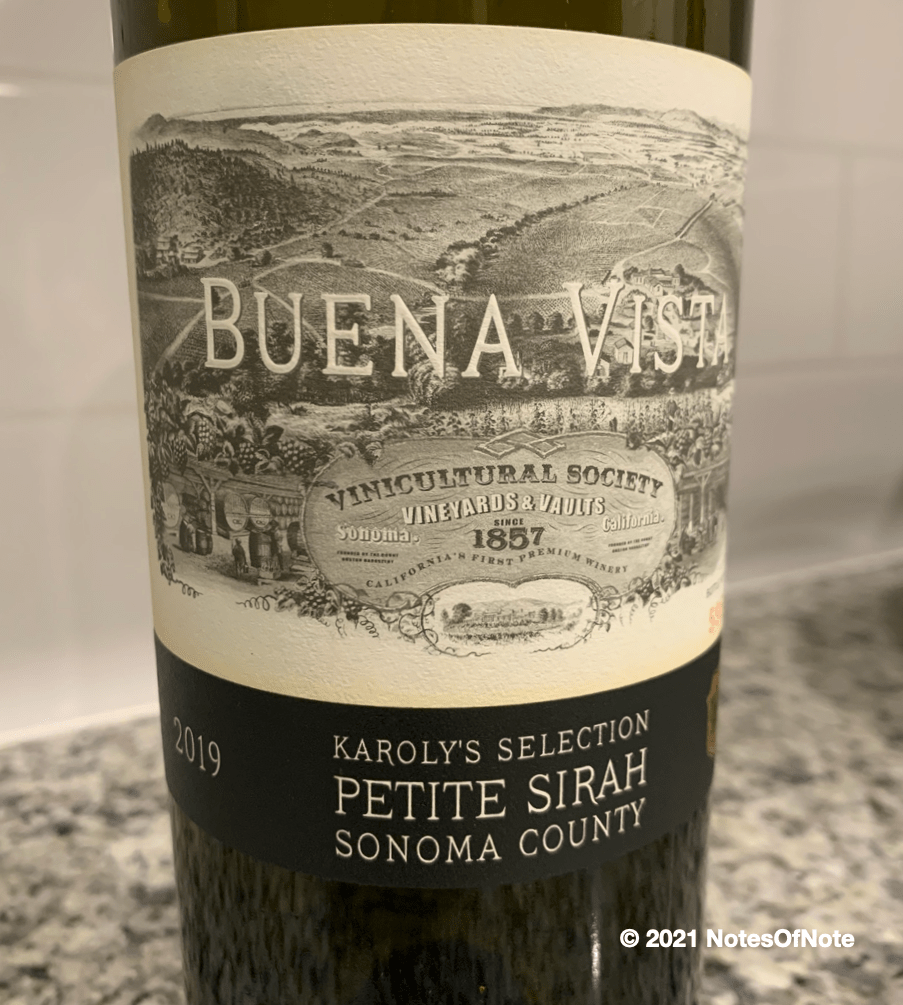
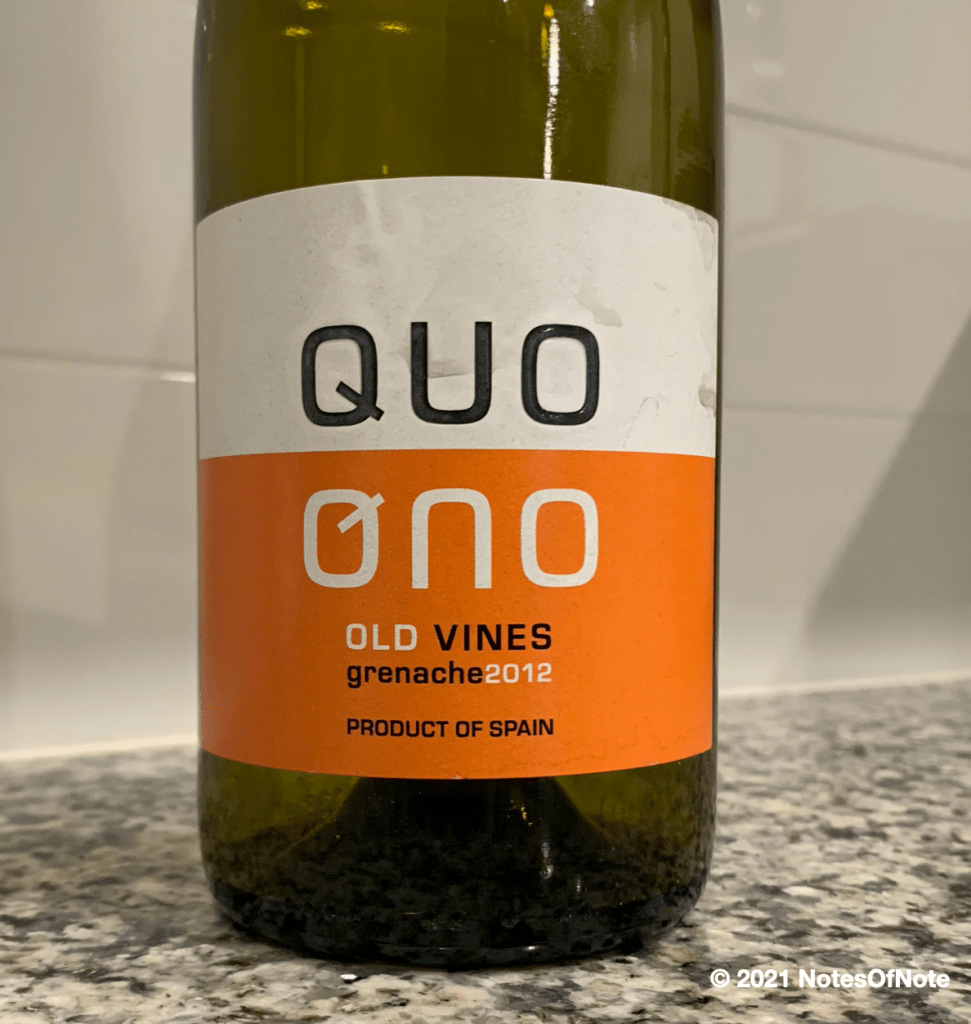
Without any further preamble, let me share the July/August/September bottles that are described thusly:
Yes, I acknowledge that certain patterns and tendencies do emerge–both in this snapshot of Q3 2021 as well as throughout Notes. Any time you’re seeking a good gift, or you’re a winemaker looking for advocates, you know where to find me. -R

The 2018 No. 8 Proprietary Red is smokin’ hot. Love this limited production wine (courtesy of Rutherford-based Verdon Estate Winery) and so very glad that my cellar has a few more of this well-crafted big red.
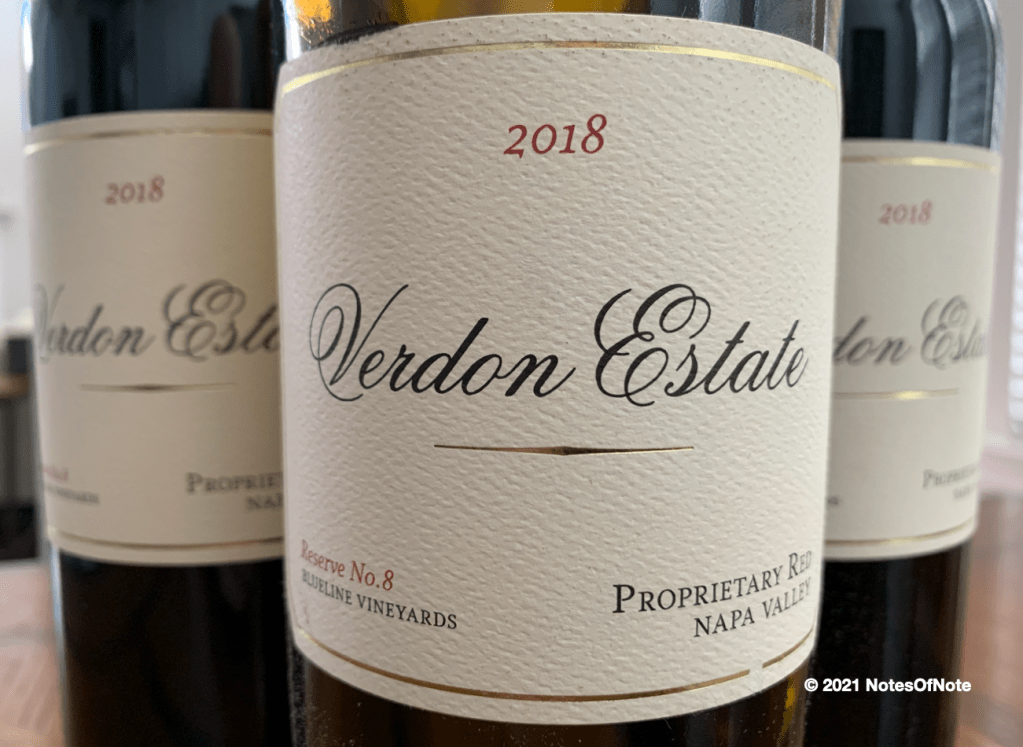
Let’s start with the particulars. First, the fruit is produced in two small, rocky vineyard sites near Duckhorn and the Napa River. Those grapes—a combination of Cabernet Sauvignon (50%), Malbec (30%), and Merlot (20%)—are then managed by winemaker Kevin Morrisey of Petrus, Etude, Stags Leap, and Ehlers fame.
That pedigree makes for a stunning wine, one that tonight accompanied a pan-seared ribeye, perfectly seasoned with just salt and pepper. The meat paired well with the No. 8 Proprietary Red, handling its tannins and dark cherry notes nicely. This 2018 bottle has the cherry and pepper hints of the Cab, and the soft underbelly of the Merlot.
“Reminiscent of a top Amarone, the blend is ethereal with divine balance, a gentle grip, a deep berry richness that carries through to the finish.”
—Verdon Estate
In the near term, Notes will have a follow-up to this first post on the 2018 Verdon Estate Blue Vineyards No. 8 Proprietary Red, and I hope you’ll check back again for further thoughts this amazing bottle engenders. In the meantime, enjoy your wine and your weekend.