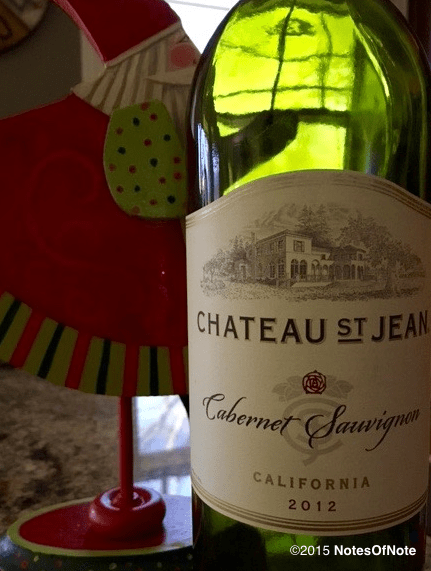
This gallery contains 5 photos.
This gallery contains 5 photos.
I enjoyed a great bottle of Conundrum earlier this year and uncorked this one to share the experience with family. We have just returned from watching the new Star Wars (good flick) and are prepping a light dinner–a “must do” after all the rich eating on Christmas. This deep ruby red is now in the glass, so let’s touch on some details:
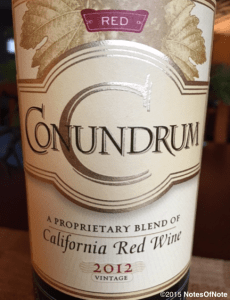
2012 Conundrum, Wagner Family, Napa Valley, California, USA.
This 2012 red blend is going to accompany a Romaine salad, tossed with Buffalo-style chicken, and accented with a crumble of Gorgonzola. It’s luscious fruits, harvested from grapes in California’s Napa Valley, are presented evenly. In the Conundrum you have less spice than a Syrah and less tannins than a Cabernet Sauvignon, but both probably contribute to this proprietary blend. In the 2012 vintage, I taste a little bit of cherry, blueberry, and even want to bite into it a bit–that’s an accent I usually attribute to a chocolatey profile of a wine. The actual blend is not disclosed by the Wagners but works to good effect in the Conundrum.
I know that the Wagner family would suggest this Conundrum be consumed not at room temperature but slightly colder; we’ll have to give that a shot next time instead. Would that have been a good contrast to the spicy Buffalo sauce? Interesting to consider. I’ll keep you posted and thanks again for following Notes here.

Christmas Day and plenty of great vino to be enjoyed. First on the docket? The 2012 Sterling Meritage, a big red from the Central Coast of California. Earlier this year I had my first Sterling, and both receive favorable marks for their depth and taste.
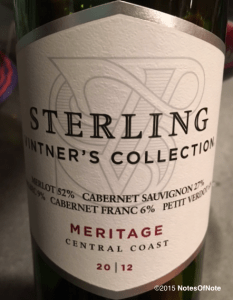
2012 Vintner’s Collection Meritage, Sterling Vineyards, Central Coast, California, USA.
This Meritage is your kitchen sink of reds–it packs in Merlot, Cabernet Sauvignon, Malbec, Cabernet Franc, and Petit Verdot, and you end up with several layers in tasting. Just check out the adjacent photo. You have the fruits (black cherry for sure), a hint of vanilla, and also some of the spice that I think comes through in the Verdot. This bottle we sampled, collectively, with hors d’oeuvres that included an amazing, thick pepperoni, olives, various crackers, and olive tapanade. Maybe some salted almonds too? Special thanks to my cousin and his bride, if you’re reading along, for this fun treat.
The main event of our dinner? A roast to die for. It had a fantastic bark to it (I know this isn’t a food blog but the beef was photo-worthy in and of itself) and the seasonings (salt, dill seed, coriander, garlic, etc.) were perfect. Yes, we had all the usual fixings with the entre, but the beef was cooked just right and carried a tremendous amount of flavor–upon request the butcher had removed the rib bones but then retied them to the meat so as to infuse them into the process. I may err in a detail or two here; again this is more about the wine but just wanted to share details on the accompanying food.
There was a hearty Bordeaux breathing in a decanter all evening, and we opened a 2009 Amantis Montecucco Sangiovese as well. This Italian red originates from the region between Montalcino and coast of Tuscany–one my reference says “succeeds at a hybrid of Brunell and Supertuscan that demonstrates a natural appropriation of the latter two regions’ superlative characters.” Some five-dollar words to say it’s a great, hearty wine with some depth to it.
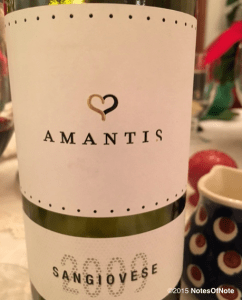
2009 Amantis Montecucco Sangiovese, Italy.
I taste black cherry here too in the Sangiovese, and rich spices that went just great with the pepper-encrusted beef. Juicy, and delicious. This 2009 could have been tart and tannic, but it wasn’t. The wine was much softer than I’d pictured, and that’s a good thing. We had this first bottle of the 2009 Amantis Montecucco Sangiovese, and a second one immediately on its heels. A third bottle, had one been along for the festivities, would have followed as well.
I’m interested in sampling again on a day where my palate hasn’t been exposed too to Bordeaux or a California red just in case I’m mixing characteristics among the reds. A fun day, though, and one embellished by good wine.

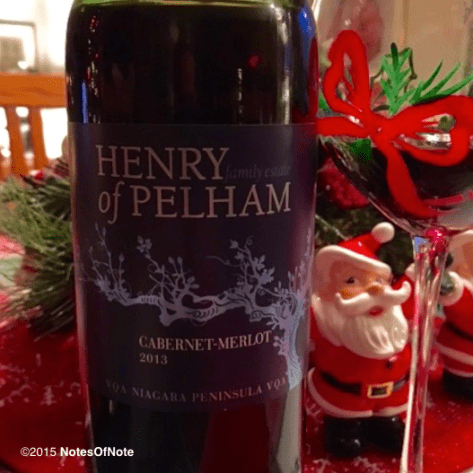
2013 Cabernet-Merlot Henry of Pelham Family Estate, Niagara Peninsula, Canada.

The 2005 Bodega Classica Hacienda Lopez de Haro Reserva kicked off our “after party” last night, a rich red Rioja that carried notes of chocolate, leather, and spice from the first taste to the last of the bottle. This bottle continued a fun evening, one that started with a fantastic crostata (prosciutto and cheese with roasted red peppers!) and a great production of A Christmas Carol. A few random Dickens facts conveyed by our playbills:
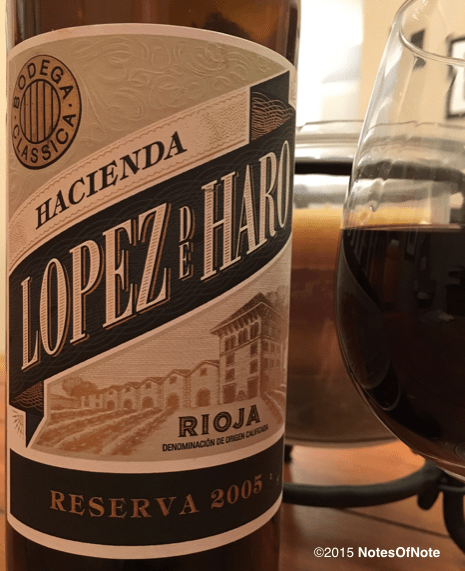
2005 Bodega Classica Hacienda Lopez de Haro Reserva, Rioja, Spain
Okay, now back to the vino. This 2005 is a red blend of 90% Tempranillo, and 5% Graciano and 5% Garnacha and hails from Bodega Classica. The winery is located in San Vincente de la Sonsierra (on the south of the Cantabrian Mountain Range and the Tolono mountains) and irrigated by the River Ebro. With good rainfall during the winter, protection from the wind and humidity, and excellent “calcareous clay” soil, Sonsierra seems particularly conducive to growing Tempranillo. Bodega Classica ages their 2005 Hacienda Lopez de Haro Reserva for 20 months in French and American oak. The product of this care? An aromatic, full red that is nearly chewy on the palate.
I could see this as a great accompaniment for cheeses, for a black-and-blue burger, or perhaps a cracked pepper accent on a grilled chicken salad or steak. It stands on some big legs. If you’re after some experts’ thoughts, allow me to present tasting notes from Parker’s Wine Advocate:
“It has a beautiful, rounded, sensual bouquet with hints of over-ripe Satsuma and gravel. The palate is medium-bodied with a touch of piquancy on the entry. It has crisp acidity and taut tannins on the dry, dusky finish but it remains extremely well-focused.”
It’s been some time since we covered a 2005 in Notes and glad to share on this occasion! Holiday fun to be sure.

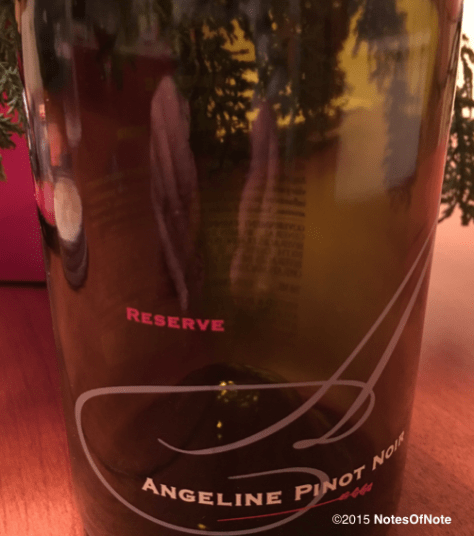
2013 Angeline Reserve Pinot Noir, Russian River Valley, Sonoma, California, USA.

The Alexander Valley I’ve “visited” on several previous occasions. Among the 30 or so vineyards of this Sonoma County AVA are Clos du Bois, Francis Ford Coppola, Rodney Strong, and Simi Winery–who produced this bold 2012 Cabernet Sauvignon.
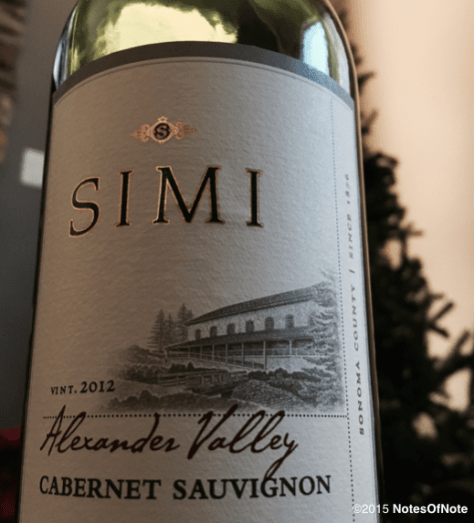
2012 Simi Winery Cabernet Sauvignon, Alexander Valley, Sonoma County, California, USA.
Tonight this Cab accompanied black and blue bacon cheeseburgers, tossed beds of greens with mustard, and crispy crowns potatoes. The blackberry flavors, tinged with subtle inferences of spice, were a juicy accent to the burgers. The Simi Winery Cabernet Sauvignon smelled almost tart in the glass, but its actual finish was far gentler and more even than its nose suggested. My wife expressed this idea far more eloquently than I am here but, like this enjoyable bottle of red, her words were fleeting and I have lost them to time and space.
Here’s how the vineyard conveyed: “Balanced flavors of red and black fruits, smooth tannins, and soft spice give way to a velvety finish.” They used fruit from Los Amigos and Red Fan, and other Alexander Valley Vineyards (e.g., Encinos, Big River, Hoot Owl Creek, and Belle Terre) to develop the final flavors in this Cabernet, which is actually a red blend of 90% Cabernet Sauvignon, 7% Merlot, 1% Petit Verdot, 1% Cabernet Franc, and 1% Malbec. (It’s the Malbec and Verdot that convey the spices, if you’re curious…)
Last couple things: the grapes fermented 32 days in stainless steel (on the skins) and ultimately aged 16 months in small oak barrels–releasing in June of 2014. It’s a good value for the price, and the 2012 Simi Cab should be readily available in your local wine store. I’d pick up another and recommend you do the same.

Silver Palm is a new Cabernet Sauvignon to this taster, and one I was glad to try this December weekend. It’s label is definitely an attention-grabber, its platinum inlay and metallic finish an inviting beacon on the shelf of our local wine store.

2012 Silver Palm, Cabernet Sauvignon, North Coast, California, USA.
We know that 2012 was a favorable year for California Cab, and that’s evident here in this dark ruby red wine. It has a definite cherry taste to it, and it is substantive. There are spices on the nose, and I’m drinking it from a Reidel glass made specifically for Cab Sauv. I think that helps bring out some of the nuances here. The finish is soft and silky; the tannins even and firm.
Says the winemaker, “We select grapes from some of the finest coastal vineyards in Northern California and, with traditional and cutting-edge artisan winemaking techniques, craft a sumptuous, seamless Cabernet.”
Enjoyed very much, both last evening with pan-seared steaks and broccoli, and again tonight with Mexican chicken soup. The 2012 Silver Palm Cabernet Sauvignon will go great with your steaks, your ribs, and virtually any meal seasoned with pepper. Or with none–just grab a bottle and give it a try.

After a few recent blue-collar bottles it was time for a palate cleanser–a nice, medium-bodied red with a lasting finish. Something closer to a Cabernet than a Zinfandel or a Pinot, and once again it was a Buena Vista wine that rang the bell.
The 2013 Count’s Selection Carignane is a member of the Boisset Collection (look that up) and worth the effort to put your hands on one. It’s 100% Carignane, a grape traditionally available in the western Mediterranean and also in California’s Central Valley, and here courtesy of Mendocino County. Buena Vista Winery only produced 175 cases of this 2013 vintage, so do the math on the possible availability of a bottle.
If you find the 2013 Count’s Selection Carignane, you should expect some flavors of blueberry and black raspberry. I’m not exactly sure what currant tastes like in a wine, but I mention it because there is a lot dark fruits in play here that I can’t quite nail down; just a bit of spice or earthiness too. And the wine wasn’t the night’s only treat, as we had this 2013 with cole slaw and baby back ribs. Those we set up with an ancho chile-based dry rub and finished after nearly six hours of low heat with a “Whammy” all-purpose barbeque sauce, picked up from a Charlotte BBQ festival.
A couple important facts regarding the wine:
1) Its grapes were harvested October 19th, 2013. I’m not sure why but I love the specificity.
2) The grapes were aged 10 months in seasoned French and Hungarian barrels.
3) Of the outcome, the winemaker remarked, “Our 2013 Carignane exudes a classically decadent nose of rich, darker fruits…”
I apologize for including no photo with this first recap, but if you check back in the next day or two I’ll be sure to share a glimpse of this delicious 2013. Thanks for reading and have a Happy Thanksgiving.

Bogle is readily available to you, I know, and if you’re reading about the 2013 Merlot on Notes Of Note it’s not because you’re wrestling over some life-changing decision with your vino. Bogle Vineyards, after all, probably has a sampling of their entire lineup in your local grocery or big box supermarket. Why then?
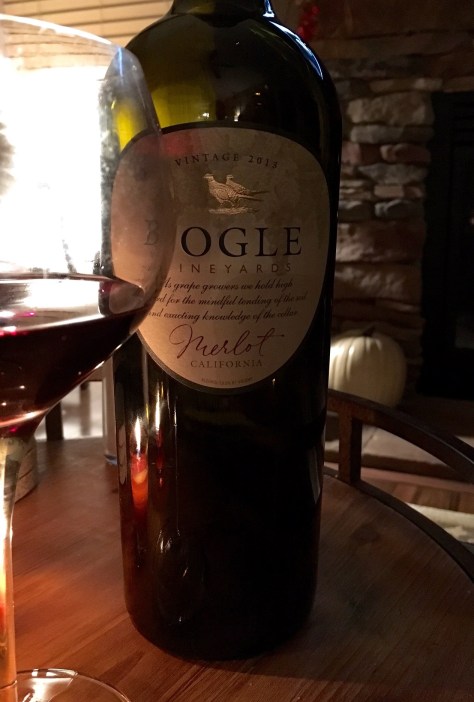
2013 Merlot, Bogle Vineyards, Clarksburg, California, USA.
You’re reading further, perhaps, because (like me) you recognize wine sometimes makes an impact on our lives that is greater than just its taste or its scarcity. Maybe you’ll come a little further and know what Bogle means to this guy?
First the nuts and bolts: This 2013 Merlot accompanied about 10 ounces of perfectly cooked steak, replete with good grill marks, a baked potato, and lemon-drizzled asparagus. It was fine in that regard, but I’d have preferred a Cabernet in hindsight.
Nevertheless, Bogle will always remind me of a great Boston meal, a work dinner with new clients. An Italian joint, steps leading down from the street to a dimly lit dining room where new colleagues met to hash out terms and next steps. We had an Amarone (which has left a similar indelible imprint on my brain) as well as the Bogle–which lit up my new contact, a world-class dental ceramist. With wild gestures from Greek hands he talked eagerly about this wine, which I’d never heard of beforehand. The wine itself is fine, but the memory of his excitement about Bogle is, oddly enough, far more lasting. It’s the kind of thing that, if you’re still reading here, is perhaps you recognize too in some of the wines you’ve tasted. Feel free to share…

 NotesOfNote