Notes’ Top 5 Wine Surprises of 2015

Again in 2015 we had the opportunity to taste and, through Notes Of Note, share feedback on some excellent wine. Several new vintages (e.g., the 2013 Buena Vistas) lived up to their previous accolades while others (the 2012 Boom Boom! Syrah, for example) were slightly behind previous years’ releases. Others were first-of-a kind adventures that will bear repeating over the coming annum. As last year, the below is not necessarily a “best of” list but some notable grapes you’d do well to sample as time permits:

Many others were better visited or better wines overall, but you’ll have to explore Notes further to decide for yourself. I appreciate your readership and raise a glass to everyone who joined in the sampling here at our home or yours this past year. Best to you all in 2016!

2012 Conundrum, Wagner Family

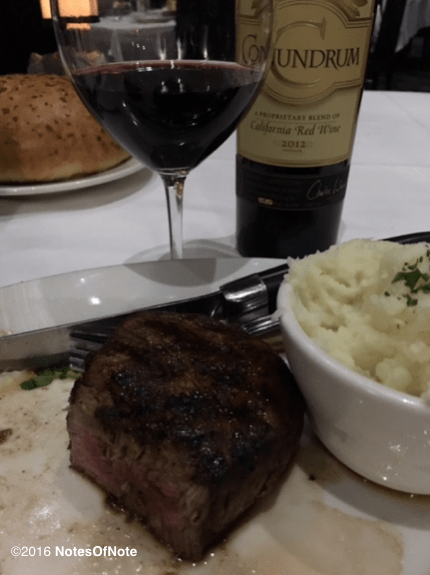
I enjoyed a great bottle of Conundrum earlier this year and uncorked this one to share the experience with family. We have just returned from watching the new Star Wars (good flick) and are prepping a light dinner–a “must do” after all the rich eating on Christmas. This deep ruby red is now in the glass, so let’s touch on some details:

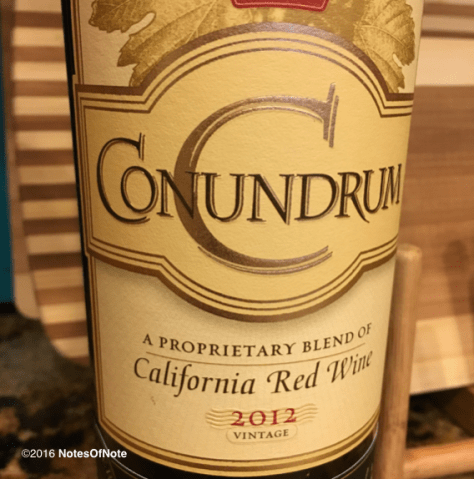
2012 Conundrum

2012 Conundrum, Wagner Family, Napa Valley, California, USA.

This 2012 red blend is going to accompany a Romaine salad, tossed with Buffalo-style chicken, and accented with a crumble of Gorgonzola. It’s luscious fruits, harvested from grapes in California’s Napa Valley, are presented evenly. In the Conundrum you have less spice than a Syrah and less tannins than a Cabernet Sauvignon, but both probably contribute to this proprietary blend.  In the 2012 vintage, I taste a little bit of cherry, blueberry, and even want to bite into it a bit–that’s an accent I usually attribute to a chocolatey profile of a wine. The actual blend is not disclosed by the Wagners but works to good effect in the Conundrum.

I know that the Wagner family would suggest this Conundrum be consumed not at room temperature but slightly colder; we’ll have to give that a shot next time instead. Would that have been a good contrast to the spicy Buffalo sauce? Interesting to consider. I’ll keep you posted and thanks again for following Notes here.


2012 Vintner’s Collection Meritage, Sterling Vineyards; 2009 Amantis Montecucco Sangiovese

Christmas Day and plenty of great vino to be enjoyed. First on the docket? The 2012 Sterling Meritage, a big red from the Central Coast of California. Earlier this year I had my first Sterling, and both receive favorable marks for their depth and taste.

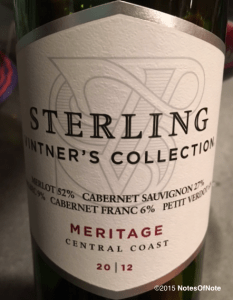
2012 Vintner's Collection Meritage, Sterling Vineyards, Central Coast

2012 Vintner’s Collection Meritage, Sterling Vineyards, Central Coast, California, USA.

This Meritage is your kitchen sink of reds–it packs in Merlot, Cabernet Sauvignon, Malbec, Cabernet Franc, and Petit Verdot, and you end up with several layers in tasting. Just check out the adjacent photo. You have the fruits (black cherry for sure), a hint of vanilla, and also some of the spice that I think comes through in the Verdot. This bottle we sampled, collectively, with hors d’oeuvres that included an amazing, thick pepperoni, olives, various crackers, and olive tapanade. Maybe some salted almonds too? Special thanks to my cousin and his bride, if you’re reading along, for this fun treat.

The main event of our dinner? A roast to die for. It had a fantastic bark to it (I know this isn’t a food blog but the beef was photo-worthy in and of itself) and the seasonings (salt, dill seed, coriander, garlic, etc.) were perfect. Yes, we had all the usual fixings with the entre, but the beef was cooked just right and carried a tremendous amount of flavor–upon request the butcher had removed the rib bones but then retied them to the meat so as to infuse them into the process. I may err in a detail or two here; again this is more about the wine but just wanted to share details on the accompanying food.

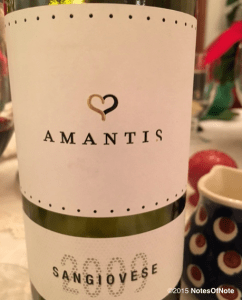
There was a hearty Bordeaux breathing in a decanter all evening, and we opened a 2009 Amantis Montecucco Sangiovese as well. This Italian red originates from the region between Montalcino and coast of Tuscany–one my reference says “succeeds at a hybrid of Brunell and Supertuscan that demonstrates a natural appropriation of the latter two regions’ superlative characters.” Some five-dollar words to say it’s a great, hearty wine with some depth to it.

2009 Amantis Montecucco Sangiovese, Italy.

2009 Amantis Montecucco Sangiovese, Italy.

I taste black cherry here too in the Sangiovese, and rich spices that went just great with the pepper-encrusted beef. Juicy, and delicious. This 2009 could have been tart and tannic, but it wasn’t. The wine was much softer than I’d pictured, and that’s a good thing. We had this first bottle of the 2009 Amantis Montecucco Sangiovese, and a second one immediately on its heels. A third bottle, had one been along for the festivities, would have followed as well.

I’m interested in sampling again on a day where my palate hasn’t been exposed too to Bordeaux or a California red just in case I’m mixing characteristics among the reds. A fun day, though, and one embellished by good wine.

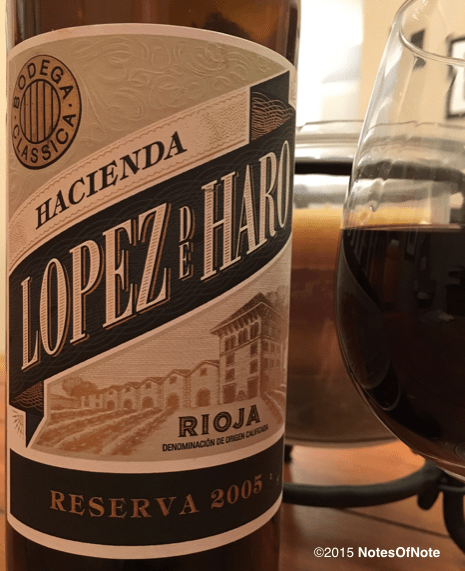
2005 Bodega Classica Hacienda Lopez de Haro Reserva

The 2005 Bodega Classica Hacienda Lopez de Haro Reserva kicked off our “after party” last night, a rich red Rioja that carried notes of chocolate, leather, and spice from the first taste to the last of the bottle. This bottle continued a fun evening, one that started with a fantastic crostata (prosciutto and cheese with roasted red peppers!) and a great production of A Christmas Carol. A few random Dickens facts conveyed by our playbills:

  • Christmas was not always a day off for workers; Scrooge’s question to Crachit, “You’ll want the whole day off tomorrow, I suppose?” helped create this expectation for us all.
  • The first commercially produced Christmas cards were printed in 1843, the same year Charles Dicken’s novel was published.
  • There is no Christmas tree in A Christmas Carol, and his characters do not exchange gifts–a tradition usually reserved for New Year’s Day celebrations in that day.
  • In the early 1800s (and thanks in part to the Puritans), Christmas was celebrated more like Halloween is today–as a time for merriment and feasting.
2005 Bodega Classica Hacienda Lopez de Haro Reserva

2005 Bodega Classica Hacienda Lopez de Haro Reserva, Rioja, Spain

Okay, now back to the vino. This 2005 is a red blend of 90% Tempranillo, and 5% Graciano and 5% Garnacha and hails from Bodega Classica. The winery is located in San Vincente de la Sonsierra (on the south of the Cantabrian Mountain Range and the Tolono mountains) and irrigated by the River Ebro. With good rainfall during the winter, protection from the wind and humidity, and excellent “calcareous clay” soil, Sonsierra seems particularly conducive to growing Tempranillo. Bodega Classica ages their 2005 Hacienda Lopez de Haro Reserva for 20 months in French and American oak. The product of this care? An aromatic, full red that is nearly chewy on the palate.

I could see this as a great accompaniment for cheeses, for a black-and-blue burger, or perhaps a cracked pepper accent on a grilled chicken salad or steak. It stands on some big legs. If you’re after some experts’ thoughts, allow me to present tasting notes from Parker’s Wine Advocate:

“It has a beautiful, rounded, sensual bouquet with hints of over-ripe Satsuma and gravel. The palate is medium-bodied with a touch of piquancy on the entry. It has crisp acidity and taut tannins on the dry, dusky finish but it remains extremely well-focused.”

It’s been some time since we covered a 2005 in Notes and glad to share on this occasion! Holiday fun to be sure.

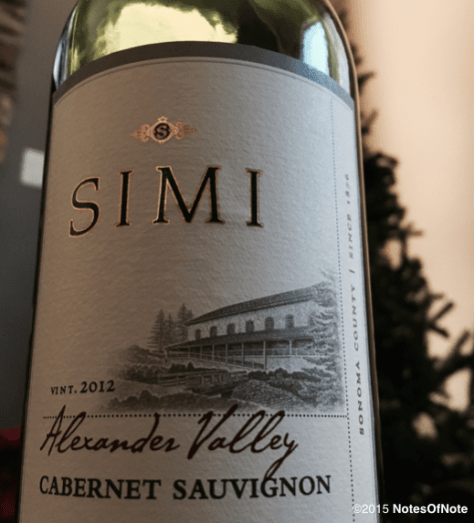
2012 Simi Winery Cabernet Sauvignon

The Alexander Valley I’ve “visited” on several previous occasions. Among the 30 or so vineyards of this Sonoma County AVA are Clos du Bois, Francis Ford Coppola, Rodney Strong, and Simi Winery–who produced this bold 2012 Cabernet Sauvignon.

2012 Simi Winery Cabernet Sauvignon, Alexander Valley

2012 Simi Winery Cabernet Sauvignon, Alexander Valley, Sonoma County, California, USA.

Tonight this Cab accompanied black and blue bacon cheeseburgers, tossed beds of greens with mustard, and crispy crowns potatoes. The blackberry flavors, tinged with subtle inferences of spice, were a juicy accent to the burgers. The Simi Winery Cabernet Sauvignon smelled almost tart in the glass, but its actual finish was far gentler and more even than its nose suggested. My wife expressed this idea far more eloquently than I am here but, like this enjoyable bottle of red, her words were fleeting and I have lost them to time and space.

Here’s how the vineyard conveyed: “Balanced flavors of red and black fruits, smooth tannins, and soft spice give way to a velvety finish.” They used fruit from Los Amigos and Red Fan, and other Alexander Valley Vineyards (e.g., Encinos, Big River, Hoot Owl Creek, and Belle Terre) to develop the final flavors in this Cabernet, which is actually a red blend of 90% Cabernet Sauvignon, 7% Merlot, 1% Petit Verdot, 1% Cabernet Franc, and 1% Malbec. (It’s the Malbec and Verdot that convey the spices, if you’re curious…)

Last couple things: the grapes fermented 32 days in stainless steel (on the skins) and ultimately aged 16 months in small oak barrels–releasing in June of 2014. It’s a good value for the price, and the 2012 Simi Cab should be readily available in your local wine store. I’d pick up another and recommend you do the same.


2012 The Aristocrat, Buena Vista

The Aristocrat is one of the finest wines I’ve ever enjoyed, and it’s going right onto Notes‘ Top Five Reds list. It’s really special. This 2012 is the inaugural vintage, and it’s already sold out at Buena Vista so coming by this gem will not be easy–yet a worthwhile pursuit if you’re even remotely inclined toward great wine.

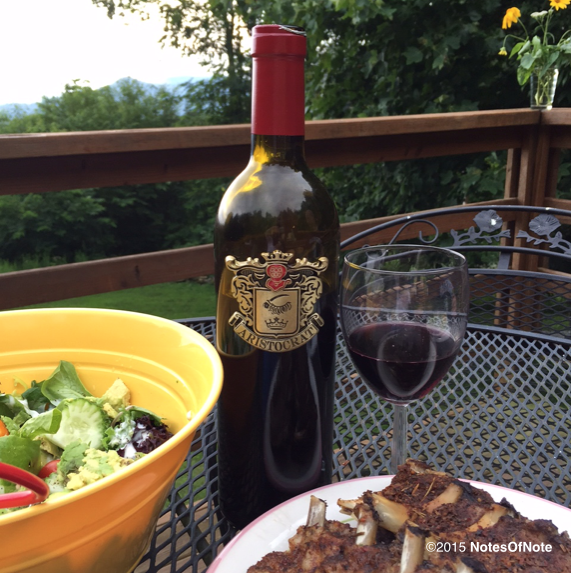
2012 The Aristocrat, Buena Vista, Sonoma County, California, USA.

2012 The Aristocrat, Buena Vista, Sonoma County, California, USA.

The 2012 Aristocrat is more cherry and blueberry in its flavor. It is crazy smooth, packed full of fruit, and has a spectacular, even finish. There is not even a hint of sharpness, of tannins, of the need for time the way you often get with a Bordeaux or similarly styled red blend. It has great legs, and a jammy color that you’ll find–like its bouquet–extremely enticing.

My wife and I enjoyed this 2012 from a mountainside cabin in western NC, along with a rack of ribs (that’s a dry rub you see in the photo) and a salad featuring some vegetables we picked up fresh at a roadside farm stand.

The team at Buena Vista did not assemble this winner haphazardly–it is filled with purpose and intention. It features Valdiguie (a first for me?), Petit Verdot, and Charbono grapes, each harvested from vineyards in Napa Valley’s Calistoga AVA.  Believe it or not, the vines of the Valdiguie, located at the base of the Vaca Mountains, date back before Prohibition. Poking through the Buena Vista website, I also relay to you that the Charbono is grown on one of Napa’s last remaining Charbono vineyards. This amazing wine is aged (in separate lots) in 100% French oak for 16 to 18 months before being blended.

Special thanks to my mother for presenting us with this amazing housewarming gift. We are thrilled at the reason you selected the 2012 Aristocrat, and thrilled too at the occasion to enjoy it. Hope we brought just a little bit of that back to you in the recap and the photos!

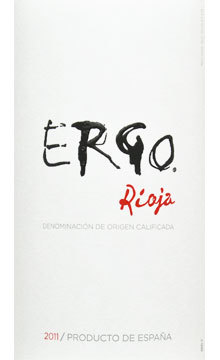
2012 Ergo, Martín Códax Rioja

Just finishing an enjoyable glass of 2012 Ergo, a last cocktail for the weekend. Fitting, perhaps, as the Ergo also ushered in our Friday evening. Like a few other youthful wines we’ve had of late, the Ergo smelled tart at first…an acidic sharpness that was not actually present in the drink itself.

2011 Ergo, Martín Códax, Rioja, Spain.

2011 Ergo, Martín Códax, Rioja, Spain.

My wife picked this wine out, possibly to accompany a Mexican chicken soup that we had earlier in the week (at which time I opted to finish an open Pinot instead), and had the same vibe as to the Ergo’s tart notes. You can also smell dark cherry and maybe just a hint of pepper in this mix of Tempranillo and Garnacha grapes?

I liked it very much. You think you’ll have a tough finish when you get a whiff of this wine’s acidity, but it’s much smoother and lighter. At the same time, it was able to muscle up nicely to thin grilled steaks–which featured a new spice rub that is still much the topic of debate in our house. (We are not sure if the rub worked or not.)

My initials jump right off the label, so I knew I was going to be a fan from the start. I have no decent photo to share this evening…at least of the 2012 Ergo. Give this wine a shot and taste for yourself.

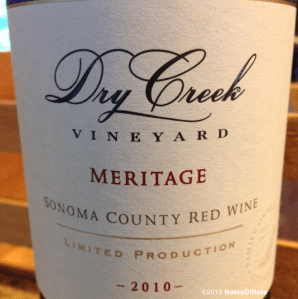
2010 Meritage, Dry Creek Vineyard

This 2010 Meritage was part of a great gift set that I received from my mother for my birthday last month. It was not supposed to be the headliner of this trio (that was due to be The Mariner) of reds, but in truth it was. We enjoyed The Mariner to be sure, but whereas that wine did not quite live up to its reputation (I still think of its sharp notes) this Limited Production 201o wine very much did.

2010 Meritage, Dry Creek Vineyard, Sonoma, California, USA.

2010 Meritage, Dry Creek Vineyard, Sonoma, California, USA.

We uncorked the 2010 without much fanfare as part of our dinner preparations and did not let it breathe before tumbling it out, fresh, berry, and vibrant, into our waiting glassware. By contrast to the vineyard’s Mariner, it is much more even and less tannic in its makeup. You get a big whiff of cherry and black berry layered together, and a subtle little ribbon of vanilla that winds through the red blend. I’ve previously broken down the mix of this big red, and I think you get that vanilla from the Cab but am not really sure. Is it perhaps the Merlot that helps get that nice, meaty balance here? Try it and let me know.

The 2010 Heritage from Dry Creek Vineyard–one of the first post-Prohibition vineyards in Dry Creek Valley–accompanied a set of delicious steaks. My wife had doctored up the meat with a great spice rub of rosemary and sage, plus the usual salt and pepper, and I for a change remembered to pull the steaks from the grill with enough time to let ’em set up nicely on our plates. Complement that and the wine with some roasted potatoes (fingerlings?) and fresh asparagus and you’ve got quite a nice spread to enjoy with loved ones.

My only disappointment was the end of the bottle, and knowing that no more of these rest comfortably on our wine shelf for next weekend. Here’s to always leaving ’em wanting…

2012 The Mariner, Dry Creek Valley

This Bordeaux-style red blend is produced by Dry Creek Valley Vineyard, a family-owned winery in northern Sonoma Valley. It’s been in the Stare family since 1972 when, inspired by trips to the Loire Valley, founder David Stare purchased an old prune orchard in Dry Creek Valley and started planting grape vines that would become his family’s winery. Today they produce single-vineyard wines, reds and whites in their “signature” series, and this Mariner–which I received as a special birthday gift.

The 2012 vintage has had accolades from various reviewers, and you can find them scattered throughout the web. If you’re still reading here on Notes, though, you’re less interested in numeric scoring or some high-brow critic’s take on this 2012 meritage. You’re looking for a “real world” analysis and I’m happy to share.

2012 The Mariner, Dry Creek Vineyard, Sonoma, California, USA.

2012 The Mariner, Dry Creek Vineyard, Sonoma, California, USA.

The first thing you should know is that the 2012 The Mariner accompanied our steak dinner on this Memorial Day weekend. My wife and I had an opportunity to slow down from the usual pace of the week, and we used it to great advantage. Our steaks were seasoned with a special home-made “proprietary” blend of spiced salt and smelled of sage, rosemary, thyme, and oregano. The steaks set for perhaps an hour, and we thought The Mariner would be a great complement, given its own hints of spice and blueberry smells. We also had corn fresh from the cob and a killer potato salad that tied the summer meal together–quite a platform on which to display The Mariner.

Here’s how the Stare family shares its summary of this delicious 2012 red blend: “The wine displays high-toned perfume aromas of rose petal, cranberry, blueberry and oregano. Several more minutes reveal hints of wild sage, allspice and dark cherry characters. The palate is full and rich with mouthfilling complexity carrying notes of espresso, sweet vanilla, anise and dark fruit tones. The tannins are smooth and supple providing balance and sophistication.” I wholeheartedly support their fruit flavors, but I am not sure the tannin profile is quite accurately posed. Even after allowing the bottle to breathe for some time, my wife noted its sharper scent on the nose and, though I thought it less pronounced in tasting, it is definitely still present (is that from the Malbec?). Not sure if aging the bottle for a longer period or perhaps decanting would bring it more in line with the winemaker’s original intentions?

The 2012 is a red blend consisting of 56% Cabernet Sauvignon, 25% Merlot, 8% Malbec, 8% Petit Verdot, and 3% Cabernet Franc, and its is aged for 20 months in French oak (50% new oak). It is very easy drinking and would be great to have another at some point in the future. The meal was fantastic, and the wine was really damn good too–there’s not a drop of this left after our Sunday dinner.