2014 Albarrada, Vinho Regional Alentejano

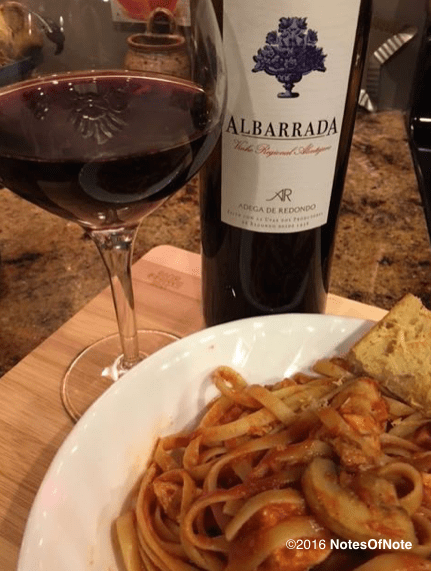
It’s a night of experimentation, with new foodstuffs and wine on the line. Let’s start with dinner–a new recipe for chicken cacciatore with fettuccine pasta and mushrooms. The chicken was light, the pasta was easy, and we kicked up the garlic-infused red sauce a notch by way of some carefully placed flakes of crushed red pepper. (Okay, we kicked up the mushrooms too, doubling what the instructions called for – we love us some shrooms!)

2014 Albarrada Vinho Regional Alentejano, Portugal.

2014 Albarrada Vinho Regional Alentejano, Portugal.

Bottled by Adega de Redondo, the wine is made from a grape that’s new to this reviewer. The 2014 Albarrada red is made from the Castelão grape and known too as the Periquita. Upon first tasting, the Albarrada reminded me very much of a Bordeaux. It is dry and fresh red fruits in ample supply, combined with a longer tannic finish. As it breathed over the evening, the Albarrada softened and showed its true colors–which are crimson red, by the way.

Even now I’m thinking about the spice in the pepper flakes and this red blend. I thought they came together pretty well, but I am less than enthusiastic about tomato sauces so might have missed some of the highlights of this combination.

What I’ll remember long after the Albarrada and the Castelão fade from my mind is the spirited kitchen ambiance and the fun of readying this delicious meal.

2014 Meiomi Chardonnay

Meiomi wine has been exceptionally good to us lately. This evening is another instance that echoes recent bottles we have had, both whites and reds, and I would encourage you to browse any of those reviews for context. It’s our first sampling of the 2014 vintage, and we picked a great meal with which to pair this aromatic white wine.

2014 Meiomi Chardonnay, California, USA.

2014 Meiomi Chardonnay, California, USA.

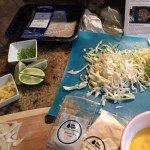
The food? Killer. A moonshot home run. You’re looking at a 2014 Meiomi Chardonnay next to Cod Kedgeree served over basmati rice, eggs, and frizzled onion. The lime garnish was a great touch too, softening the curry spices (a blend of kedgeree spices) and bringing some light refreshment to the dish. The result, courtesy of Blue Apron and a fun evening in the kitchen doing the prep work, was a mix of warm and cool, of spice and sweet. I’m not sure I’ve had a Chardonnay under better circumstances, all told.

The cod kedgeree in the prep stage.

The cod kedgeree in the prep stage.

As shared in previous Notes regarding Meiomi, the winemaker sources these grapes from multiple AVAs throughout California and brings them together in a proprietary blend. There is some orange in the aromas, some other citrus fruits, and a luscious mouthfeel. It sounds weird to observe that it tastes liquid, or solid, but both kind of make sense as I reflect back on the 2014 now. Some thoughtful planning had two bottles of the 2014 on hand as we started in on this adventure, and when we finished the first we had #2 primed and ready.

Though we do prefer the 2013 to the 2014 Meiomi, the latter made for quite a fantastic dining (cooking too!) experience.

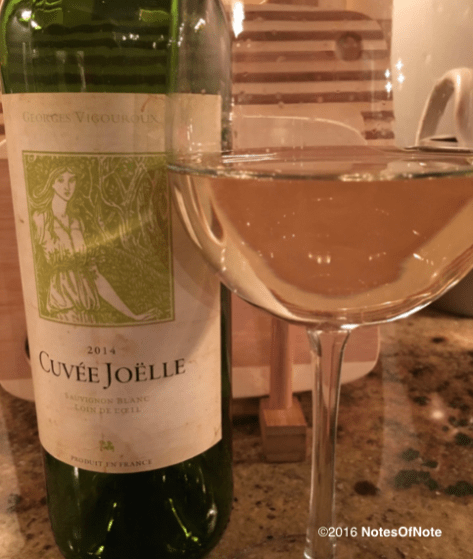
2014 Cuvée Joëlle White Blend

The Georges Vigouroux winery in France produces the 2014 Cuvée Joëlle White Blend, a new bottle we received in a recent mail order shipment. It’s new to our house and this blog, and I’m still wrestling with my notes to find something worthwhile to pass along here for anyone who was interested enough to click.

2014 Cuvée Joëlle White Blend

2014 Cuvée Joëlle White Blend, France.

My palate for white wine is very unrefined, and that’s a key limitation when sampling a bottle as layered as the 2014 Cuvée Joëlle. It’s a blend of Sauvignon Blanc (60%) and a grape entirely new to me, the Loin De L’oeil (40%). As I do some reading on the latter, I understand it’s the Loin that gives the wine the vibrancy and balance I tasted. Virtually every review of white wine uses “citrus” in some form to describe the wine, and this one should as well. You definitely get some of that in the Cuvée Joëlle. It’s less about flowers and more about fruit notes–yet still reminds me of when you cut into green flower stalks and get a whiff of their chlorophyl?

I can also tell you it’s not as dry as other Sauv Blancs I’ve had, but more dry than sweet. And I have no clue whatsoever a ‘gooseberry’ is in this importer’s description: “This blend of Sauvignon Blanc and Loin De L’oeil gives flavors of gooseberry and citrus with notes of green.” If that means something to you, then great. Just passing along a possible nugget your way.

Have your own opinion of what it means to order a bulk shipment with no previous expectation with the agent or the wines. Me? I think it a new adventure that exposed me to grapes and wines I would likely stroll past in my local wine store. Wines such as the 2014 Cuvée Joëlle White Blend remind you that it’s good to take Frost’s road every now and again.

2014 Gascon Malbec

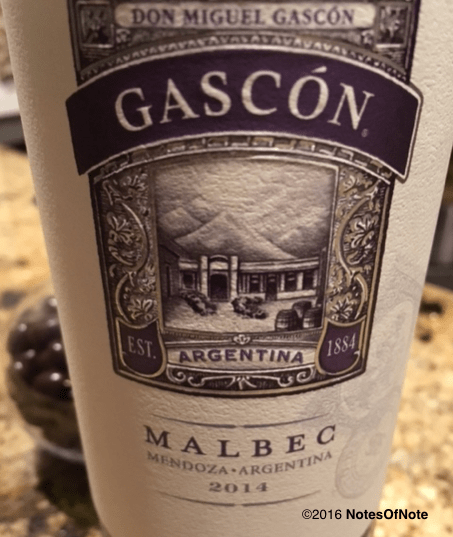
The 2014 Gascon Malbec, originating from the Mendoza region of Argentina, was exactly the kick of spice and dark fruits that I wanted tonight to accompany my steak. I opted for London Broil and a side salad, and the pepper seasoning of the meat and the onions in the mixed greens needed something substantive in terms of wine pairings. The Gascon lived up to the task.

2014 Gascon Malbec, Mendoza, Argentina.

2014 Gascon Malbec, Mendoza, Argentina.

This isn’t my first bottle of Gascon but first of the vintage. The Notes review of the 2009 you can read here. What of the Mendoza region?

  • Mendoza is responsible for nearly two thirds of all Argentinian wine production.
  • It is located in the foothills of the Andes mountains, which is one of the highest elevations for grape growing worldwide.
  • Mendoza soil is predominantly loose sand over clay, which means less to this reviewer but is perhaps relevant to you, reader, so I include nevertheless.
  • The region has only a few centimeters of rain all year, which means its vineyards depend on irrigation, but with four seasons and no extreme temperature swings Mendoza sounds highly conducive to grape growing.

The result of all this environment? A rich, layered Malbec that has blackberry and pepper spices to offer. It pours dark and luscious in the glass, and has great aromas that I can’t quite define for you. It’s full. It’s got a really nice, even finish. The 2014 Gascon is readily available at your local grocery store or wine distributor, and it is very affordable at less than $15 per bottle. Needless to say it complemented the meal effectively.

Of the 2014 Gascon Malbec, the winemaker says, “Dark fruit flavors intertwine with notes of spice, licorice, and chocolate to create a magnificent, full-bodied Malbec.

I recently enjoyed “high altitude” wine in the form of the 2005 Bodega Classica Hacienda Lopez de Haro Reserva, which is too small a sample size to know if the altitude is an influence on my tastes or merely coincidence. A good hypothesis to explore, though, right? The journey is sometimes even better than the destination.

2014 Mark West Pinot Noir Black

Notes has chronicled more than a single bottle of Mark West over the years; our favorite wine store in New Jersey often stocked it and gave us ample opportunity to sample with all manner of foodstuffs. A quick glance back at our archives says more than five vintages have been covered herein. Never before, however, had I seen this “Dark” variation and was intrigued as to its potential.

2014 Mark West Pinot Noir Black, Monterey County, California, USA.

2014 Mark West Pinot Noir Black, Monterey County, California, USA.

I had sort of drifted away from the West Pinot in recent months. I find winemaker Jason Becker’s “signature” Pinot to be slightly lacking in muscle, a light red that skipped some of the subtleties of good California grapes–almost like “diet” Pinot Noir. That being said, even the hint of a darker red in the Black label was promising and raised my eyebrow. Immediately I knew I had to give it a go much like I did the Apothic Dark when stumbling onto it in Chicago last year.

I uncorked it first on Friday after a travel week but am polishing it off tonight–mostly with a London broil and a peas and carrots medley. The vegetables are not the highlight of the meal, to be sure. I’m happy to share it’s the Black that holds the spotlight this evening.

It’s got much better legs than the ‘original’ Mark West, and packs in blackberry smells in abundance. This wine is a far cry from a Cab or deeper red, but also more saturated than a traditional Pinot. You get a whiff of vanilla too–faint but definitely present. Good swirl in your glass and mouthfeel for an affordable red. Becker, who uses the Saignée method of winemaking here, describes the flavor as “ripe black plums and blackberries along with mocha notes…” and ages this line extension in French and Hungarian oak barrels.

I’m glad I gave this Pinot Noir a try and definitely prefer it to the classic Mark West. Give it a go and taste for yourself.