2014 Gascon Malbec

The 2014 Gascon Malbec, originating from the Mendoza region of Argentina, was exactly the kick of spice and dark fruits that I wanted tonight to accompany my steak. I opted for London Broil and a side salad, and the pepper seasoning of the meat and the onions in the mixed greens needed something substantive in terms of wine pairings. The Gascon lived up to the task.
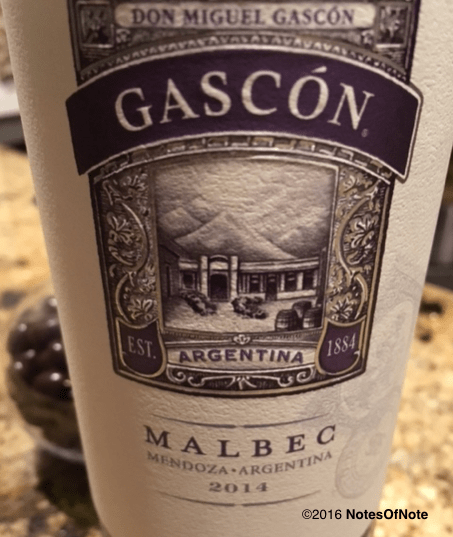
2014 Gascon Malbec, Mendoza, Argentina.

2014 Gascon Malbec, Mendoza, Argentina.

This isn’t my first bottle of Gascon but first of the vintage. The Notes review of the 2009 you can read here. What of the Mendoza region?

  • Mendoza is responsible for nearly two thirds of all Argentinian wine production.
  • It is located in the foothills of the Andes mountains, which is one of the highest elevations for grape growing worldwide.
  • Mendoza soil is predominantly loose sand over clay, which means less to this reviewer but is perhaps relevant to you, reader, so I include nevertheless.
  • The region has only a few centimeters of rain all year, which means its vineyards depend on irrigation, but with four seasons and no extreme temperature swings Mendoza sounds highly conducive to grape growing.

The result of all this environment? A rich, layered Malbec that has blackberry and pepper spices to offer. It pours dark and luscious in the glass, and has great aromas that I can’t quite define for you. It’s full. It’s got a really nice, even finish. The 2014 Gascon is readily available at your local grocery store or wine distributor, and it is very affordable at less than $15 per bottle. Needless to say it complemented the meal effectively.

Of the 2014 Gascon Malbec, the winemaker says, “Dark fruit flavors intertwine with notes of spice, licorice, and chocolate to create a magnificent, full-bodied Malbec.

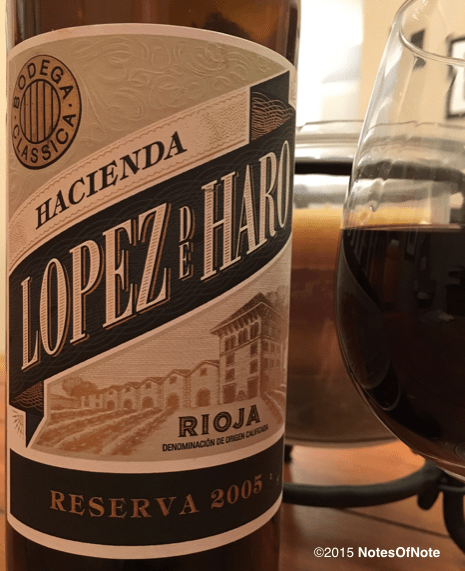
I recently enjoyed “high altitude” wine in the form of the 2005 Bodega Classica Hacienda Lopez de Haro Reserva, which is too small a sample size to know if the altitude is an influence on my tastes or merely coincidence. A good hypothesis to explore, though, right? The journey is sometimes even better than the destination.

2014 Mark West Pinot Noir Black

Notes has chronicled more than a single bottle of Mark West over the years; our favorite wine store in New Jersey often stocked it and gave us ample opportunity to sample with all manner of foodstuffs. A quick glance back at our archives says more than five vintages have been covered herein. Never before, however, had I seen this “Dark” variation and was intrigued as to its potential.

2014 Mark West Pinot Noir Black, Monterey County, California, USA.

2014 Mark West Pinot Noir Black, Monterey County, California, USA.

I had sort of drifted away from the West Pinot in recent months. I find winemaker Jason Becker’s “signature” Pinot to be slightly lacking in muscle, a light red that skipped some of the subtleties of good California grapes–almost like “diet” Pinot Noir. That being said, even the hint of a darker red in the Black label was promising and raised my eyebrow. Immediately I knew I had to give it a go much like I did the Apothic Dark when stumbling onto it in Chicago last year.

I uncorked it first on Friday after a travel week but am polishing it off tonight–mostly with a London broil and a peas and carrots medley. The vegetables are not the highlight of the meal, to be sure. I’m happy to share it’s the Black that holds the spotlight this evening.

It’s got much better legs than the ‘original’ Mark West, and packs in blackberry smells in abundance. This wine is a far cry from a Cab or deeper red, but also more saturated than a traditional Pinot. You get a whiff of vanilla too–faint but definitely present. Good swirl in your glass and mouthfeel for an affordable red. Becker, who uses the Saignée method of winemaking here, describes the flavor as “ripe black plums and blackberries along with mocha notes…” and ages this line extension in French and Hungarian oak barrels.

I’m glad I gave this Pinot Noir a try and definitely prefer it to the classic Mark West. Give it a go and taste for yourself.

2005 Bodega Classica Hacienda Lopez de Haro Reserva

The 2005 Bodega Classica Hacienda Lopez de Haro Reserva kicked off our “after party” last night, a rich red Rioja that carried notes of chocolate, leather, and spice from the first taste to the last of the bottle. This bottle continued a fun evening, one that started with a fantastic crostata (prosciutto and cheese with roasted red peppers!) and a great production of A Christmas Carol. A few random Dickens facts conveyed by our playbills:

  • Christmas was not always a day off for workers; Scrooge’s question to Crachit, “You’ll want the whole day off tomorrow, I suppose?” helped create this expectation for us all.
  • The first commercially produced Christmas cards were printed in 1843, the same year Charles Dicken’s novel was published.
  • There is no Christmas tree in A Christmas Carol, and his characters do not exchange gifts–a tradition usually reserved for New Year’s Day celebrations in that day.
  • In the early 1800s (and thanks in part to the Puritans), Christmas was celebrated more like Halloween is today–as a time for merriment and feasting.
2005 Bodega Classica Hacienda Lopez de Haro Reserva

2005 Bodega Classica Hacienda Lopez de Haro Reserva, Rioja, Spain

Okay, now back to the vino. This 2005 is a red blend of 90% Tempranillo, and 5% Graciano and 5% Garnacha and hails from Bodega Classica. The winery is located in San Vincente de la Sonsierra (on the south of the Cantabrian Mountain Range and the Tolono mountains) and irrigated by the River Ebro. With good rainfall during the winter, protection from the wind and humidity, and excellent “calcareous clay” soil, Sonsierra seems particularly conducive to growing Tempranillo. Bodega Classica ages their 2005 Hacienda Lopez de Haro Reserva for 20 months in French and American oak. The product of this care? An aromatic, full red that is nearly chewy on the palate.

I could see this as a great accompaniment for cheeses, for a black-and-blue burger, or perhaps a cracked pepper accent on a grilled chicken salad or steak. It stands on some big legs. If you’re after some experts’ thoughts, allow me to present tasting notes from Parker’s Wine Advocate:

“It has a beautiful, rounded, sensual bouquet with hints of over-ripe Satsuma and gravel. The palate is medium-bodied with a touch of piquancy on the entry. It has crisp acidity and taut tannins on the dry, dusky finish but it remains extremely well-focused.”

It’s been some time since we covered a 2005 in Notes and glad to share on this occasion! Holiday fun to be sure.

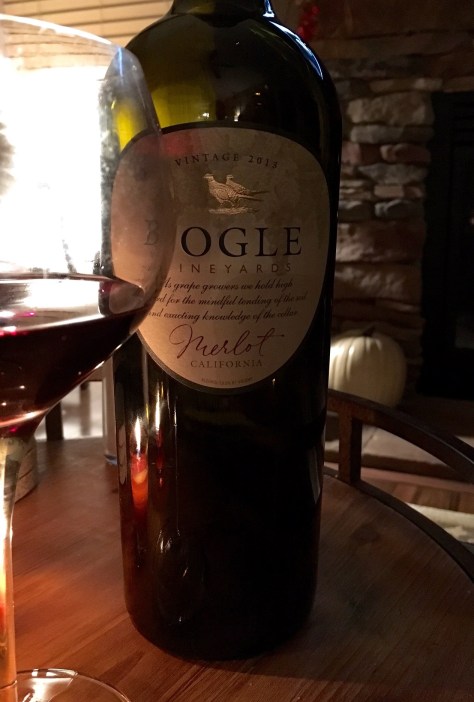
2013 Merlot, Bogle Vineyards

Bogle is readily available to you, I know, and if you’re reading about the 2013 Merlot on Notes Of Note it’s not because you’re wrestling over some life-changing decision with your vino. Bogle Vineyards, after all, probably has a sampling of their entire lineup in your local grocery or big box supermarket. Why then?

2013 Merlot, Bogle Vineyards, Clarksburg, California, USA.

2013 Merlot, Bogle Vineyards, Clarksburg, California, USA.

You’re reading further, perhaps, because (like me) you recognize wine sometimes makes an impact on our lives that is greater than just its taste or its scarcity. Maybe you’ll come a little further and know what Bogle means to this guy?

First the nuts and bolts: This 2013 Merlot accompanied about 10 ounces of perfectly cooked steak, replete with good grill marks, a baked potato, and lemon-drizzled asparagus. It was fine in that regard, but I’d have preferred a Cabernet in hindsight.

Nevertheless, Bogle will always remind me of a great Boston meal, a work dinner with new clients. An Italian joint, steps leading down from the street to a dimly lit dining room where new colleagues met to hash out terms and next steps. We had an Amarone (which has left a similar indelible imprint on my brain) as well as the Bogle–which lit up my new contact, a world-class dental ceramist. With wild gestures from Greek hands he talked eagerly about this wine, which I’d never heard of beforehand. The wine itself is fine, but the memory of his excitement about Bogle is, oddly enough, far more lasting. It’s the kind of thing that, if you’re still reading here, is perhaps you recognize too in some of the wines you’ve tasted. Feel free to share…

2013 A to Z Pinot Noir

Rarely, it seems, do I take an opportunity to point the compass north from California and its bounties in order to sample some of the goodness that hails from the northwest corner of the country. This weekend, however, I’ve done just that and set my sights on the 2013 A to Z Pinot Noir. The A to Z originates in Oregon and did not impress right from the start.

2013 A to Z Pinot Noir, Willamette Valley, Oregon, USA.

2013 A to Z Pinot Noir, Willamette Valley, Oregon, USA.

To be fair, I picked up two of these bottles in my latest wine adventure so perhaps it’s just this first one that came off as lackluster. I had high hopes going in, as the northwest has a great reputation for wine because of its climate, terroir, etc. Is it crazy that I found the A to Z bland?

Yes, it eventually gained some momentum with me, both over time and repeated sampling–we all know how that goes. I am used to Pinot Noir that has a characteristic pale red color, and the A to Z answered the bell in this respect. Aromas of cherry, strawberries, and often vanilla. But I’m also accustomed to spice nuances, a whiff of raspberries, that swirls in your glassware and gives a deeper layer to your tasting experience. And the A to Z really didn’t do this–it was sort of flat by contrast.

I had the A to Z with two different meals–a dish of salted-and-buttered penne pasta, and pecan-encrusted chicken breasts (with accompanying vegetable sides). The 2013 vintage held up more effectively with the chicken, but it was almost too light to match up with the pasta. Didn’t really anticipate that outcome.

Reading about this wine after the fact, I realize how much my tasting experience has differed from that of others. One meaningful comment from a tenured wine aficionado read, “The 2012 A to Z Pinot Noir invites with vibrant aromas of juicy berries, cherries, lavender and violets, evolving to clove, game, smoke and cherry tobacco. A succulent, focused attack has flavors of blue and red fruits, flowers and earth, then deepens with hints of mocha, gingerbread, green tea and cacao.

Sounds fantastic! That profile would be right up my alley, and would be a drink I’d be pleased to share early and often with guests, family, friends, you name it. But the 2013 A to Z that I sampled was just…even…measured…and felt like it took no risks. Rest assured I’m going to be paying close attention to bottle two when it’s eventually cracked, but the wine has a lot of recovery to do in my book. Good luck and tell me what you think. It’s readily available at your local wine store I’m sure.

2012 North Coast Chardonnay, William Hill Estate Winery

This was a multiple­-night Chardonnay, and that usually means one of two things: 1) either the white didn’t have enough time to breathe, or 2) the accompanying food disappeared faster than the vino. In our house, whites are consumed infrequently and even less often once the fish or chicken is gone.

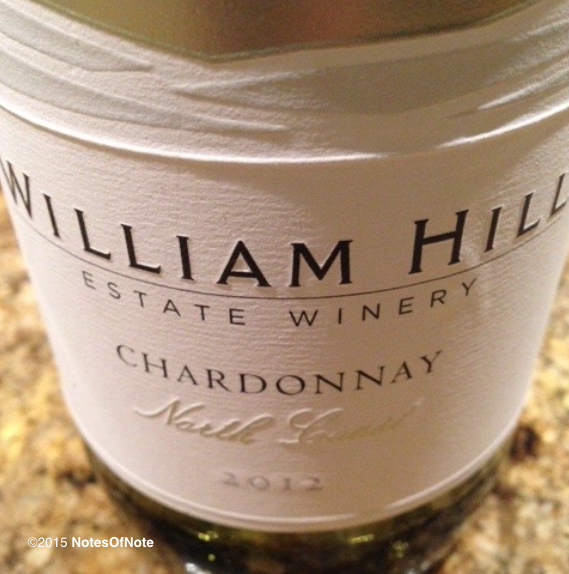
2012 North Coast Chardonnay, William Hill Estate Winery, Napa Valley, California, USA.

2012 North Coast Chardonnay, William Hill Estate Winery, Napa Valley, California, USA.

The William Hill North Coast has good branding, and a label that is not unlike a Mondavi. The embossing is a nice touch too, but I didn’t think this white quite lived up to this appearance. It was not sweet (which gets no love whatsoever in Notes) at all, and had some light floral and citrus (definitely pear) notes to it­­–but so do practically all whites. So how did this 2012 differentiate itself?

Said plainly, it really didn’t. I have yet to research this vintage of the William Hill, and I don’t know its cooperage­­, but I’m betting this was not aged in oak. I’m thinking stainless steel instead. Some of the warmth (what I often hear described as “buttery”) I equate with an oak barrel was not present here. This is not to say it was metallic tasting, but it was just uneven.*

Enjoyed the chance to try something new here, in the 2012 William Hill North Coast Chardonnay, but I am satisfied and file now under “been there, done that.”

*Postscript. The winemaker described, “This well-balanced wine has a robust fruit finish.” And they also state that a “portion” of this wine is aged in stainless steel at a maximum temperature of 62°F and the rest fermented in barrels at “an ambient cellar temperature of approximately 65°F.” Bingo!

2013 Trivento Malbec Reserve

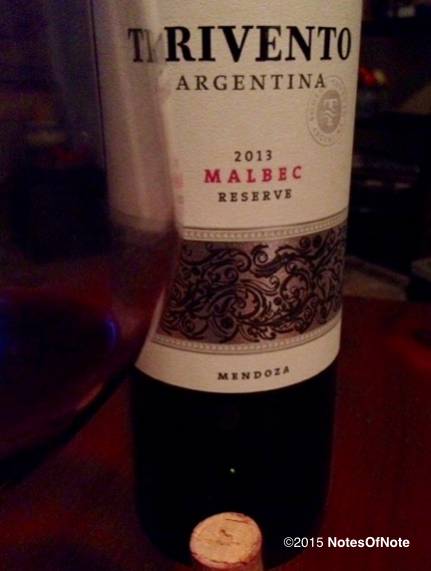
At least once previously I’ve been treated with this wine of the three winds – the Polar, Zonda, and Sudestada – courtesy of the God of Winds Eolo. I’m achy all over, tired, and am going to cheat just a little, offering you this link to Notes‘ previous tasting notes rather than coming up with a new profile for you this evening. Hopefully you’ve read enough of this column to forgive my brevity tonight–you know I’ll make it up with some interesting nuggets in the future.

2013 Trivento Malbec Reserve, Mendoza, Argentina.

2013 Trivento Malbec Reserve, Mendoza, Argentina.

It’s a weeknight and football is on in the background. Finished this red with a grilled New York strip steak, a mixed green salad, and some yellow beans. Some good portion control all around means I enjoyed the inky, red goodness of the Malbec–its mouthfeel, its plum taste–and might even have room for dessert. Hoping you are readying for a good weekend and good beverages too.