2010 Tezza Corte Majoli Amarone della Valpolicella

Several years ago–perhaps even a decade–I had occasion to join colleagues and clients at a high-end working dinner in Manhattan (or Boston?) in discussion of potential collaboration.  No longer can I remember on what fare we dined, or how I enjoyed the meal, but I can remember with stark clarity the two wines that we enjoyed.  One was Bogle, and the first time I’d been exposed to that winemaker, and the featured twin was an Amarone–also a first for me.  The Amarone was remarkable and a grape that I set out to find nearly a month ago, off and on, with no tangible outcome.
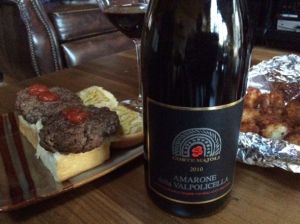
2010 Tezza Corte Majoli Amarone della Valpolicella, DOCG, Veneto, Italy.

2010 Tezza Corte Majoli Amarone della Valpolicella, DOCG, Veneto, Italy.

Wine stores here in town didn’t seem to carry Amarone, and it hadn’t appeared on any of the online sites we frequent.  And then, unexpectedly, we stumbled across this intensely flavored red at a high-end grocery store in the city and absolutely snapped it up–unsure of what to expect in the 2010 Tezza Corte Majoli Amarone della Valpolicella.  It was first sampled together with home made sliders that were so large they strained toward “burger” classification in their size and substance. Topped with crispy dill pickles and just the right amount of mustard, the sliders were a perfect way to kick off a Memorial Day of grilled treats and a perfect companion for the Amarone.

It was sweet, it was deep, it was ridiculously purple, and its berry scent swelled from the glass to greet your nose.  The 2010 vintage from Corte Majoli had a long finish and immediately made me wish we had additional bottles to savor.  As I now research, Amarone della Valpolicella is made from dried grapes in the Veneto region of northeastern Italy and is one of the region’s most recognized and prestigious reds. It results from the efforts of Veneto winemakers who sought out ways “to increase the body, complexity, and alcohol content of their wines” by concentrating the natural sugars and aromatics in Valpolicella wines.

These grapes are picked in whole bunches and kept in drying rooms (via the “appassimento” process) for 3 to 12 weeks until they are gently pressed and the “must” is fermented to dry. Their high sugar content translates to a stronger wine (15% to 16% alcohol) after fermentation, one that is barrel-aged for a minimum of two years prior to commercial release.

Our 2010 Amarone della Valpolicella from Tezza Corte Majoli was remarkable upon its debut and again the following evening when we polished it off with grilled steaks, blue cheese salads (yes a staple on our table), and some miscellaneous crispy crowns, onion rings, and the like. As I contemplate good vino options for an upcoming weekend with friends at a lake getaway, the 2010 Tezza Corte Majoli Amarone della Valpolicella makes a compelling case for inclusion.  The only tragedy one encounters with this rich red is when it’s gone.


Note: Special acknowledgment to Wine Searcher for assistance on the profile and process associated with the amarone style.


2011 Stemmari Cabernet Sauvignon, Feudo Arancio

No photo of our meal this time, friends, but hopefully still an informative synopsis of the 2011 Stemmari Cabernet Sauvignon from the good folks at Feudo Arancio.  Is this our first Cabernet Sauvignon from Italy? That’s a distinct possibility and, if the Stemmari is any indication, a trip we’ll look forward to repeating.

Two different meals we ultimately enjoyed with the graces of the 2011 Stemmari–1) tender, spice-seasoned pork chops that retained all their innate juices thanks to our Char-Broil grill, and 2) a small feast of tacos, a deft mixture of crisp vegetables and spicy fillings, each possessing similar characteristics that rolled together with the Italian Cab and made for nodding heads in our home.

This is how the winemaker outlined goals for the 2011 Stemmari: “Intense and aromatic wine with violet red color and characteristic hints of cranberry that are accompanied by spicy oak notes. Ideal with grilled red meats, game, charcuterie, and aged cheeses.

We obviously prioritized the grilled meat aspect of this recommendation, and to good effect.  Even after repeated recorking and revisiting over subsequent evenings, the wine held its own. It was never too sharp, too tart, or too tannin-laden to savor. To the contrary, it was one of those bottles that you tip and look into, questioning your eyes, even after the last drop is drained into your glass. It leaves you wanting more. This delicious red was recommended to us by the staff of a fun wine store that we sought out based on a review from a Charlotte native–and one we’re excited to revisit soon.


2011 Petite Petit, Michael David Winery

The 2011 Petite Petit from Michael Davis Winery is bursting at the seams with fruit flavor. It packs a wallop of dark fruits and has a subtle underpinning of charcoal that leads to a rich, enjoyable finish. We opened this red late on a Saturday evening, with the sun’s light fading in the distance and smell of  T-bone steaks wafting in the still air.

2011 Petite Petit, Michael David Winery, Lodi, California, USA.

2011 Petite Petit, Michael David Winery, Lodi, California, USA.

So much fruit here! It pours purple so deep and dark that it looks almost like chocolate tumbling into your glass, and its earthiness is fragrant, big, and lush. According to the team at Michael Davis Winery, this is a blend of 85% Petite Sirah and 15% Petit Verdot and offers a “joyous explosion of color and fun!” I’m here to confirm they are not exaggerating with such claims.  The Petite Petit is full-bodied and almost like jam on the finish.

We had the 2011 Petite Petit with those grilled steaks, baby fingerling potatoes, and blue cheese salads on the side. You almost want to bite, to chew this wine just like the delicious foodstuffs gracing our plates. Here’s what Robert Parker offered about this vino: “This soft, opaque purple-colored wine exhibits impressive density as well as lots of blueberry fruit intermixed with graphite, licorice, and a hint of tar.

I’m not a fraction of the experienced taster that Parker is, but the flavors here stand up to be counted and I was able–even with my humble palate–to identify several of the most developed layers. Hadn’t had a glass of wine in more than a week and this one is a great means of breaking that unwelcome streak. Be sure to try the 2011 Petite Petit for yourself.

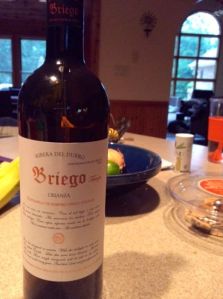
2009 Bodega Briego Crianza

Somehow we’ve managed to have three previous bottles of this 2009 Crianza, crafted from 20-year-old vines in the Ribera del Duero, Penafiel region of Spain, and have yet to jot out some thoughts for Notes visitors. Let us remedy this oversight today and share some technical information that may be helpful to your exploration of this red–cherry red–beauty.

2009 Bodega Briego Crianza, Castilla Leon, Spain.

2009 Bodega Briego Crianza, Castilla Leon, Spain.

The 2009 Bodega Briego Crianza is a red blend, a dry French- and American-oak-aged wine, that comes from Fernando, Gaspar, and Javiaer–the Benito Hernando brothers–and the village of Fompedraza, Spain. It’s got promise, this delicious Ribera del Duero.

Some tasting notes that I simply collect and offer here from my knowledgeable pros: “Strong characteristics of the Temperanillo grape variety. Ripe red fruit aromas – blackberries, strawberries, cherries, raspberries, etc. – followed by delicate notes of tobacco, caramel, eucalyptus, wood aging characteristics – cinnamon, vanilla, cumin, etc. All provide the qualities of a great wine full of expression and complexity.

All that being said, I found it not quite as good as advertised. I’ll add that it was smooth, more dark fruit (plum? not quite blackberries?) than red, but there is a little something of the latter in here nonetheless. It’s subtle but present. We had the 2009 Bodega Briego Crianza with various meals, and at various times of the evening, but must have rushed each instance as I’m doing a little catch up with this entry post facto. Hopefully the overdue post still shares a bit of the profile so you can decide if it’s a good option for you and yours.

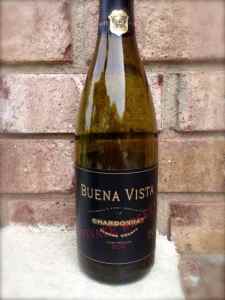
2012 Private Reserve Chardonnay, Buena Vista

This one burned a hole in our pocket.  This top-notch Chardonnay arrived just a week ago as part of an April shipment from our friends at the Buena Vista Wine Club and is already a part of Notes.  But with Spring well underway here in our home, whites are in greater demand and I can see a shift on the horizon as reds will have to accept whites on more equal footing.

2012 Private Reserve Chardonnay, Buena Vista, Sonoma County, California, USA.

2012 Private Reserve Chardonnay, Buena Vista, Sonoma County, California, USA.

The 2012 Private Reserve Chardonnay had a chance to refrigerate all weekend and was nice and chilled by the time we uncorked after work today.  In comparison to a Pinot Grigio, this white had a much richer, flavor-filled density to it.  Some Grigio is almost like water to this taster, the Coors Light of white wines; the Buena Vista Chardonnay (this one in particular) was the succulent alternative.  There are plentiful floral notes in the 2012 Private Reserve, and definitely some citrus too…without some of the “oak barrel” that we occasionally find less ingratiating. (By way of clarification: I want to taste the complexities that result from this aging process without having the barrel dropped on my tongue…I think my wife shares the same sentiments.)

This is how the Buena Vista team articulated their concept: “The 2012 Private Reserve Chardonnay is sourced from vineyards throughout Sonoma County and displays fresh citrus notes that are accented by hits of baked apple and vanilla.

I don’t usually warm up too much to vanilla, but it’s not really the dominant scent or taste in the 2012 Private Reserve Chardonnay.  Having enjoyed time in Sonoma, I like to picture the winemaker, in compiling the right grapes for this varietal, sampling many of the same vineyards that we too hit in wine country.  I know that is an unrealistic expectation but nice remembrance nevertheless.  Oh yeah–last but not least.  We had this white with a flavorful ham, reheated from our fabulous Easter brunch, broccoli, and a homemade macaroni and cheese (with real melted cheese!).  The food was good, but the Chardonnay was the star of the show.

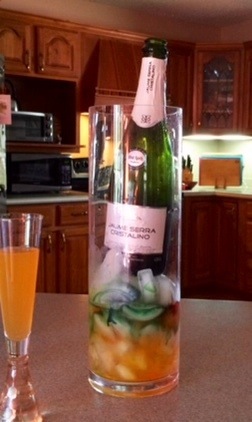
Jaume Serra Cristalino Sparkling Wine

Just finishing now a refreshing glass of the Jaume Serra Cristalino Cava Brut on the patio, enjoying the sun and the company this beautiful Easter Sunday. This sparkling wine started in mimosas with brunch – light and refreshing – and now sits bubbling in a flute, throwing reflections of the Carolina sun back toward the heavens.

20140420-160303.jpg

It’s a soft, dry white with (obviously) floral notes, a Spanish sparkling wine crafted in the traditional method. Just today I learned that this means secondary fermentation occurs in the bottle itself. Wine & Spirits Magazine has already recognized the performance of the Jaume Serra Cristalino, so it’s no surprise if you arrive at this post more informed of its profile than I am even now.

I can say it was affordable and fared well against more expensive champagne to which I would have compared the Jaume Serra Cristalino. We had this sparkling wine with glazed ham, French Toast casserole, and scrambled eggs (with cheese!). Not your typical Sunday and the the Brut stood well in this occasion. We tend to drift more often to big reds in this house but were happy today called for something a little different.

2008 Chateau Franc-Cardinal Cotes de Bordeaux

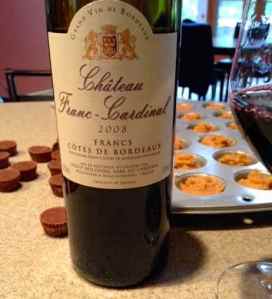
When you receive swanky cool Bordeaux glassware for your birthday, you have to put your hands on a Bordeaux in swift order.  For us, it was the 2008 Chateau Franc-Cardinal Cotes de Bordeaux.  The bottle made its first appearance on Friday evening, welcoming this gent home from a long week of business travel (is there another kind?).  While the Bordeaux breathed and wafted its purple-fruited cheeriness into our kitchen, another project was underway–see the peanut butter cookie / peanut butter cup minis in the accompanying photo?

2008 Chateau Franc-Cardinal Cotes de Bordeaux

2008 Chateau Franc-Cardinal Cotes de Bordeaux, France.

I’m sorry to say this red blend did not get its due on Friday, as this traveler was road weary and candidly only ate a quick tuna sandwich.  Suffice it to say, no sommelier has ever recommended the 2008 Chateau with tuna on white…but that’s what made tonight’s pairing all the better.  This evening, we ate this rich Bordeaux with homemade cheese burgers, seasoned fries, and all the fixings.  The burgers were massive, juicy, and cooked to perfection–no small feat given all the rain that fell here yesterday and again today.  They dripped goodness and oozed with flavor–the grilled meat a perfect complement to the wine.

The 2008 Chateau Franc-Cardinal Cotes de Bordeaux is an interesting red blend–72% Merlot, 24% Cabernet Franc, and 4% Malbec.  Every producer of a big red has his or her own take on ratios and grapes to be sure, and this one does a lot right.  Like the Bordeaux glasses, this bottle was a birthday gift and the perfect close to this day.  Upon tasting you definitely notice its tannins (even at day two) and tangy underpinnings.  I am sure blackberry figures into your tasting of the 2008 much as it did mine; I would also suggest the 2008 Chateau Franc-Cardinal Cotes de Bordeaux binds some tobacco of sorts, some faint earthiness into its profile.

I’m still mulling over its aftertaste and will curious as to your thoughts too.  Offer ’em here if you feel so inclined…and thanks for reading.

2010 Castle Rock Cabernet Sauvignon

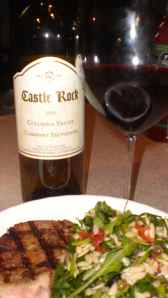
Fantastic bottle of red from Castle Rock Winery.  The grapes for this 2010 Cabernet Sauvignon are grown in Columbia Valley vineyards that (seemingly) share the same latitude as the Bordeaux region of France.  That’s an interesting fact in particular because the Castle Rock followed immediately on the heels of a Bordeaux that earned some praise in Notes — but what a contrast between the two.

The 2010 Castle Rock Cabernet Sauvignon, with Columbia Valley grapes cellared and bottled in Geyserville, California, USA.

The 2010 Castle Rock Cabernet Sauvignon, with Columbia Valley grapes cellared and bottled in Geyserville, California, USA.

The 2010 Castle Rock Cabernet Sauvignon had a richer and fruitier taste to it, with berry scents released immediately upon the pour.  The Cadillac was fine, but the Castle Rock was by far the superior wine to this palate.  Lots of black berries in this one, and much smoother finish by comparison.  The Chateau Close la Chapelle was the red blend, but it was the Castle Rock that seemed to weave in more spices, more flavors…a definite winner in their head-to-head matchup.

I do wonder, though, how much of this can be attributed to the stemware?  We do have a specially shaped Cabernet Sauvignon glass (a Syrah and Pinot Noir glass too–thanks Bec) but not a Bordeaux glass.  I’ve learned that the right glass opens the bouquet the right way, and even directs the flow of wine to the appropriate taste buds upon drinking so there’s some validity to the question.

This 2010 is aged in French oak barrels for 18 months “to soften and add complexity” and accompanied a delicious grilled tuna steak and an arugula/orzo salad.  High marks all across the board and we know exactly how to get more of each treat.  Good roadmap for you too.

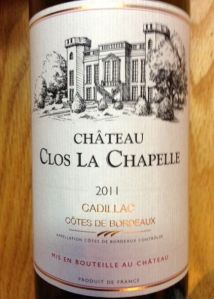
2011 Chateau Close la Chapelle, Cotes de Bordeaux Cadillac Red Blend

“Cadillac Bordeaux” gives one a definite impression even before drinking, and these grapes do the moniker justice. We opened this bottle last evening with dinner (a delicious, cheesy enchilada with salty black beans riding shotgun), and polished it off tonight with our hors d’oeuvres–the perfect follow-up to a warm, Carolina afternoon filled with hiking and outdoor fun.

2011 Chateau Close la Chapelle, Cotes de Bordeaux Cadillac Red Blend, Bordeaux, France.

2011 Chateau Close la Chapelle, Cotes de Bordeaux Cadillac Red Blend, Bordeaux, France.

Even without a long breathing period this Cotes de Bordeaux Cadillac Red Blend was easy on the palate, a dark and rich mix of berries…with no harshness that you’d find in a Syrah or similar.  It has hints in it…hints that I can’t quite place but evidence of a richer heritage than my paltry experience can identify.  Suffice it to say, several refills later found me happy and healthy and wise.  Who hasn’t been to this place?

Here’s how the experts called it: “This soft, plush cuvee offers notes of black cherry, peat moss, blackberry, cassis, toast, vanilla, cedar, and coconut.

Overstated, to be sure, but not too far off the mark.  Those same experts said to drink the 2011 Chateau Close la Chapelle, Cotes de Bordeaux Cadillac Red Blend with grilled pork and rosemary.  Sounds smart, but my wife’s experiment with the enchilada was solid too.  The Cadillac Bordeaux is a rich tapestry, and you’ve got to give this one a try.  It’s a mix of Merlot, Cabernet Sauvignon, and Cabernet Franc that is aged in stainless steel and French Oak barrels for about a year.  We received the bottle as part of a mail order so can’t quite ante up again ourselves–but we would if we could.